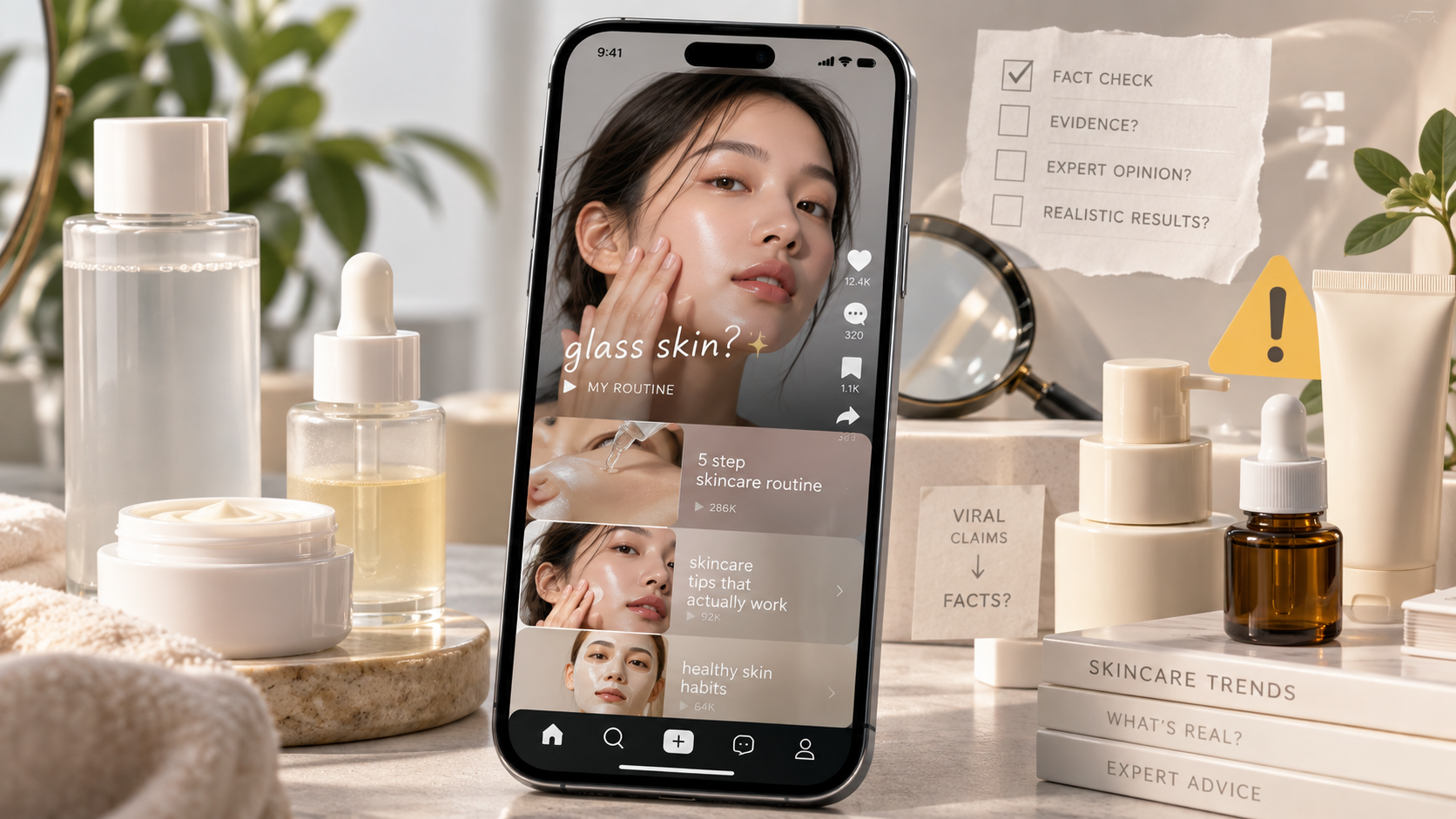
Korean skincare is having a global moment. So is “glass skin.”
But research presented at EADV Congress 2026 raises a more uncomfortable question: how reliable is the skincare advice going viral with it?
Researchers reviewed 38 popular TikTok videos related to Korean skincare and “glass skin.” Thirty-six of them — 94.7% — contained at least one potentially misleading claim.
That does not mean 95% of Korean skincare is misleading. It does not even mean 95% of all K-beauty content on TikTok is misleading.
The study looked at a specific sample of 38 popular videos selected through five search terms in May 2026.
3 FACTS
38 videos - The number included in the final analysis.
36 of 38 - 94.7% contained at least one potentially misleading claim.
84% - Failed to account for differences between skin types.
What did the researchers actually study?
Researchers searched TikTok in May 2026 using a neutral account with no previous engagement history, aiming to reduce the effect of personalization.
They screened top videos across five search terms related to Korean skincare and “glass skin.” After exclusions, 38 remained.
The videos were evaluated for dermatological claims, safety information, overall quality and reliability using the Global Quality Scale and a modified version of DISCERN.
This was not a random sample of every K-beauty video on TikTok.
It therefore cannot be used to estimate the exact percentage of all K-beauty content on TikTok that is misleading.
What did they find?
According to the study:
- 84% did not account for differences between skin types.
- 45% recommended combinations of multiple active ingredients without adequate safety guidance.
- 32% promised immediate results.
- Only one of 38 mentioned irritation risk.
- Only two of 38 discussed sun protection.
- None mentioned contact dermatitis risk.
- None recommended consulting a dermatologist.
- None cited an external source or reference.
The researchers classified all 38 videos as either unreliable or less reliable under their assessment system.
“Potentially misleading” does not mean “false”
The study did not conclude that every claim in 36 videos was false.
A claim can be potentially misleading because it is oversimplified, universalized or presented without enough context.
A routine might contain useful ingredients and still be misleading if it suggests the same combination is appropriate for everyone.
The study did not test Korean skincare products
The researchers did not test Korean skincare products in a laboratory or conclude that K-beauty products were ineffective or unsafe.
They analyzed TikTok content about skincare routines.
The researchers stressed that Korean skincare itself was not the problem. Their concern was that ideas such as gentle cleansing, hydration and barrier care can become complex, one-size-fits-all social-media routines without enough safety guidance.
A separate 94-patient study should not be mixed with this one
At the same congress, researchers presented a separate observational study involving 94 patients who developed a new skin condition or saw an existing condition worsen after using cosmetic or dermatological products promoted on social media.
Those patients were not linked to the same 38 TikTok videos.
The two studies should not be presented as though the first group of videos directly caused the 94 patient cases.
Is this a peer-reviewed journal study?
Not yet.
The findings were presented at EADV Congress 2026 in Vienna, held from September 30 to October 3.
EADV says the public abstract book is normally published about eight weeks after the congress.
So this should currently be described as research presented at EADV Congress 2026, not as a fully published peer-reviewed journal paper.
What should viewers actually do?
The practical lesson is not to avoid Korean skincare.
It is to be more skeptical of universal routines.
Before copying a viral routine, ask:
- Does the creator explain which skin types it suits?
- Are multiple active ingredients being combined?
- Is irritation discussed?
- Is sunscreen mentioned when relevant?
- Are instant results being promised?
- Is there any source behind the medical claim?
WHY IT MATTERS
K-beauty now travels globally through social media almost as quickly as products themselves.
The problem begins when trend becomes routine and routine becomes a medical claim without safety context.
The important number is not simply 94.7%.
It is 36 videos out of a specific sample of 38.
That is concerning, but it is not the same thing as saying Korean skincare itself is misleading.
WHAT TO WATCH NEXT
- Publication of the full EADV 2026 abstract book.
- Whether the research is later published in a peer-reviewed journal.
- Larger studies covering more platforms, languages and creators.
- How brands and creators respond to scrutiny around safety claims.