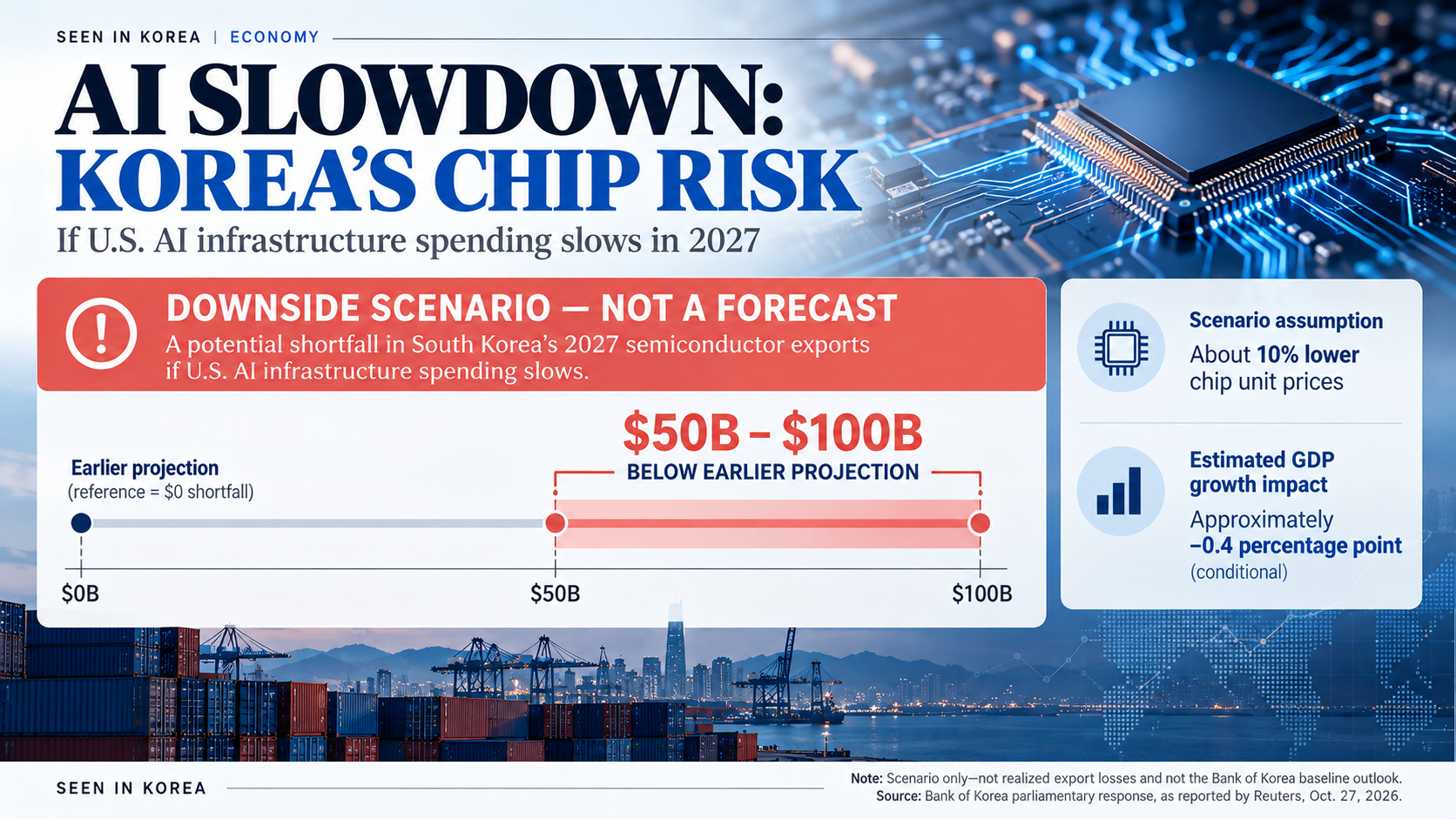
A sharp slowdown in US artificial-intelligence infrastructure spending could leave South Korea's semiconductor exports tens of billions of dollars below previous expectations in 2027. But the alarming figure is not a prediction that $100 billion of actual exports will disappear. It is a conditional downside scenario, reported by Reuters on October 27, based on analysis prepared by the Bank of Korea for a lawmaker.
What happened
Reuters reported that the central bank examined the exposure of Korean chip shipments to a less favorable global AI investment cycle. In the pessimistic case, chip export revenue could come in $50 billion to $100 billion below earlier forecasts. The scenario included an assumption of a 10% decline in Korean chip prices. These assumptions should never be presented as events that have already happened.
The number that matters
The relevant measure is the difference between a forecast and a stressed alternative outcome, rather than a forecast of absolute exports. That distinction changes how the reader should interpret the size. A $100 billion shortfall against an earlier projection is not the same thing as a $100 billion year-on-year fall in observed exports. The reported downside case also assumed a decline in Korean chip prices; this is a sensitivity assumption, not an observed price change.
The analysis also suggested a possible reduction of approximately 0.4 percentage point in Korean GDP growth under adverse conditions. A percentage point change in annual growth is not a 0.4% loss of the total stock of the economy, nor is it a corporate earnings forecast. The exact results depend on the scenario's assumptions.
Why it matters in Korea
Memory chips are deeply integrated into the spending of companies building and expanding AI data centers. That has helped Korea deliver rapid export growth, but it connects a large part of national manufacturing performance to capital budgets set abroad. Even when factories are efficient and globally competitive, sales can weaken when end customers defer new server investments or memory prices decline.
The wider effect can pass through equipment orders, supplier investment, tax receipts and employment. Such transmission is a potential economic pathway, not an already measured result of the stress test.
Why this matters outside Korea
The story runs both ways. Overseas AI companies rely on memory and other components supplied by Korean manufacturers, while Korean producers rely on data-center investment continuing at sufficient scale. A cooling AI cycle would therefore be a supply-chain story, not merely a local Korean stock-market event.
The risk—and what could change
The greatest risk in reporting this scenario is overstatement. Data-center spending could remain strong, other chip markets could recover, and prices could move differently from the scenario. The BOK's published baseline and any stress sensitivity should be kept on separate lines. Reuters' report is also a secondhand account of material provided to lawmakers; readers should distinguish it from a publicly available full BOK technical paper.
How to stress-test a technology boom
A useful stress test starts with a clear baseline. Analysts ask what would happen if buyers spent less on infrastructure, chip prices declined, and Korean firms could not offset the changes through other products or markets. The outcome is a sensitivity calculation—not evidence that consumers, companies or regulators have already taken those actions. Credible reporting should state both the assumed shock and the modelled response.
Volume and prices are also different channels. Korean producers could ship more physical units yet receive less revenue if selling prices fall sharply. Conversely, supply constraints could keep prices elevated even when demand growth moderates. Exports expressed in dollars add a further currency dimension. None of these relationships justifies claiming a precise impact without the modelling assumptions.
A slowdown in US hyperscaler spending would not necessarily affect every Korean technology company equally. High-bandwidth memory, commodity DRAM, NAND storage and related manufacturing equipment face different end markets and contract structures. Moreover, long-term investments are planned over years, not only quarterly budgets. Investors and policymakers should therefore examine company-level disclosures before generalizing a national downside figure to every producer.
Why the reference forecast is crucial
Consider two hypothetical outcomes: an export forecast of $300 billion that turns into $220 billion, and an observed $220 billion in exports followed by a fall to $140 billion. Both feature an $80 billion difference, but only the second describes an actual year-on-year loss. The Bank of Korea sensitivity reported by Reuters concerns the former type of comparison: an alternative outcome relative to an earlier projection. Those hypothetical figures are purely illustrative and are not estimates for Korean chip exports.
Readers should also distinguish the source of demand from the location of fabrication. US technology-company capital expenditure can support supply chains across multiple countries, often through several layers of equipment makers and semiconductor customers. A weaker spending plan would be a signal worth monitoring, but its final transmission to Korean exports depends on procurement schedules, pricing and customer inventories. These are reasons to scrutinize the risk rather than reasons to treat a stress scenario as the central forecast.
What we're watching
Quarterly capital-spending guidance from major US cloud providers, memory contract prices, Korean customs data and any future full BOK methodology release. The correct conclusion is that concentration creates a material vulnerability—not that the loss is certain.