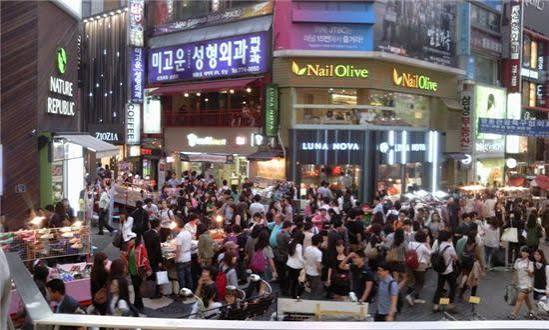
A growing group of Japanese visitors is treating Seoul less like a long vacation and more like a highly compressed repeat trip.
The pattern is being described as a "bullet trip": one or two nights packed with shopping, food, beauty treatments and late-night activity.
By the numbers
3.5 days Average Seoul stay for Japanese visitors in 2025
71.2% Revisit rate among Japanese visitors to Seoul
5.9 days Average Seoul stay for Chinese visitors
6.0 days Average Seoul stay for Taiwanese visitors
3.65 million Japanese visitors to Korea in 2025
68% Share of those Japanese visitors who were women
34% Share of all Japanese visitors who were women in their 20s and 30s
48.0% Share of Japanese visitors' key Seoul consumption activity in medical and wellness categories in first-half 2026 city data
Shorter stays, higher repeat visits
Japanese visitors stayed in Seoul for a shorter period than Chinese or Taiwanese travelers, according to the 2025 Seoul Tourism Survey.
But their revisit rate was higher.
That creates a different type of tourism behavior.
Instead of trying to see everything in one long trip, repeat visitors can come back for specific purposes: skin care, shopping, restaurants, beauty appointments or a neighborhood they already know.
Beauty is central to the itinerary
Medical and wellness services accounted for 48.0% of Japanese visitors’ major consumption activities in Seoul in the first half of 2026, followed by shopping at 24.3%, food at 17.7% and accommodation at 9.2%.
That helps explain why a one-night or two-night trip can still generate a dense amount of consumption.
Search behavior is changing too
The Korea Times, citing Google Trends analysis, reported that Japanese searches related to private body scrubs in Seoul rose more than tenfold over five years.
Searches connected to Myeongdong beauty treatments and Dongdaemun shopping also rose sharply.
That suggests travelers are increasingly planning around specific activities rather than generic sightseeing.
Seoul is adapting to the shorter trip
The city has been expanding late-night and early-morning tourism under its broader 24-hour-city strategy.
A Seoul Night Super Pass is scheduled to launch in November, according to the city's tourism plans.
For visitors with only 24 to 48 hours, opening hours and transportation become part of the tourism product itself.
The more useful question is no longer simply "What should I see in Seoul?"
It is:
"What can I realistically fit into one night and two days without wasting half the trip in transit?"
That is a practical guide SEEN IN KOREA should build next.