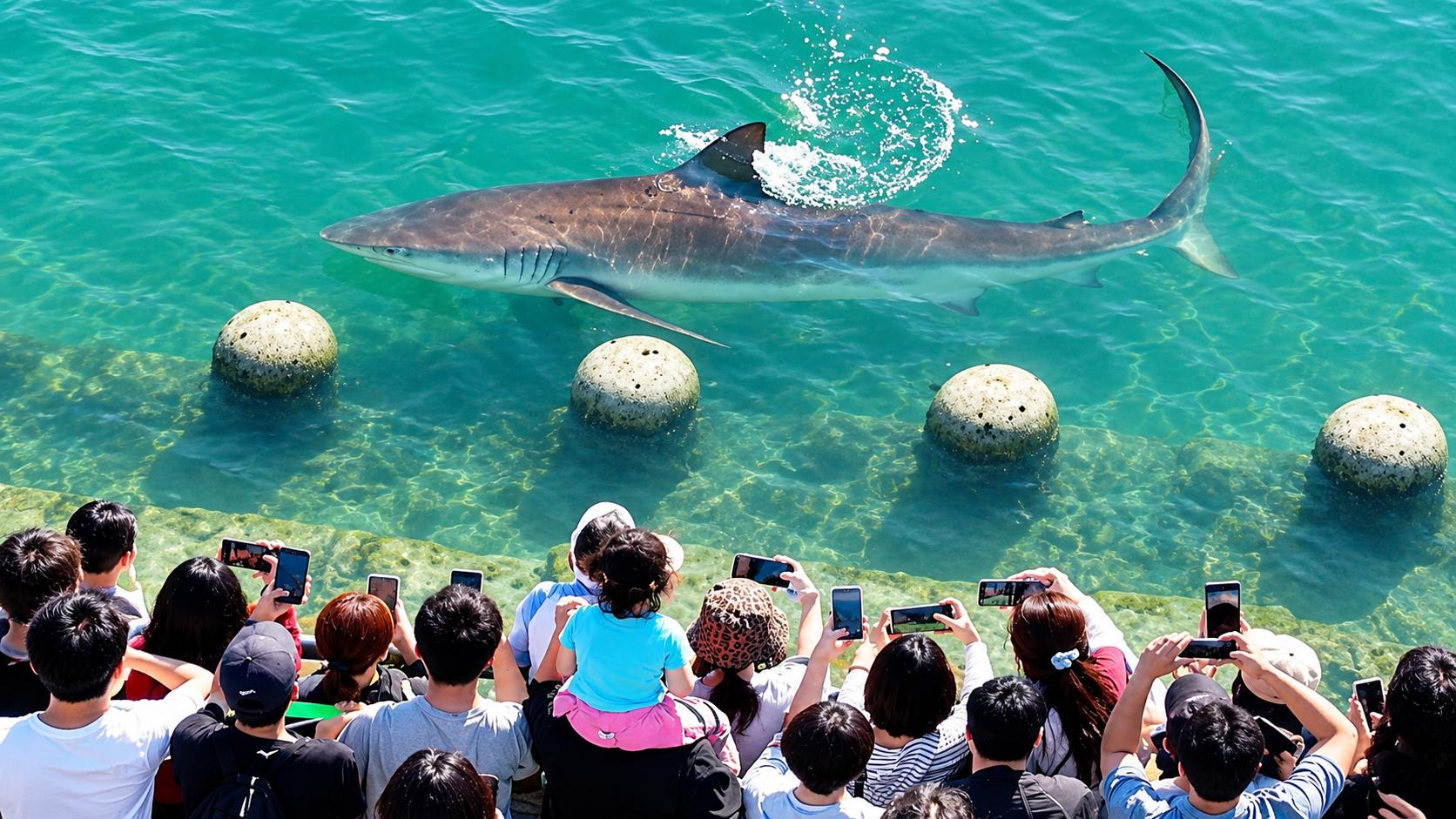
A shark has become one of Busan's most unexpected attractions.
Since September 18, a roughly 3.5-meter shark nicknamed "Bukang-i" has been circling an artificial canal at Busan's North Port Waterfront Park.
More than 600,000 people have visited the area to see it.
But the story is no longer just about a viral animal.
Authorities have now tried twice to guide the shark back to the open sea, and the second operation on October 2 was suspended before the animal could be released.
3 FACTS
3.5 meters - Approximate length of the shark.
600,000+ - Visitors drawn to Busan North Port after the shark appeared.
Oct. 2 - A second rescue attempt using a custom net was suspended.
How did a shark end up in a city canal?
Bukang-i was first spotted on September 18 inside a narrow artificial waterway at North Port Waterfront Park.
The shark is believed to be a bronze whaler, although some reports have described the identification cautiously.
Authorities and marine experts believe it may have followed prey into the canal and then struggled to find its way back out.
The waterway is close to high-rise buildings, transport infrastructure and a public park - one reason the sight became so unusual.
Instead of seeing a shark offshore, visitors could watch one circling inside an urban waterfront space.
600,000 people came to see it
The shark quickly became a local phenomenon.
By late September, more than 600,000 visitors had come to North Port, according to figures cited by Busan authorities and major news agencies.
During the Chuseok holiday alone, the site drew hundreds of thousands of visitors.
Busan later gave Bukang-i an honorary promotional role after an online poll showed strong public support.
The nickname combines "Bukhang," the Korean name for North Port, with the Korean suffix "-i."
Why rescue attempts have been difficult
The first major attempt used vessels and water streams to try to guide Bukang-i toward the sea.
The shark avoided the operation and remained in the canal.
On October 2, authorities tried a different approach.
A custom-made net about 50 meters long and 6.8 meters high was used with boats and personnel positioned along the waterway.
The goal was to slowly narrow the shark's available space and guide it toward the sea.
The operation was suspended after the net risked becoming caught on underwater rocks and structures.
Authorities left the net positioned to limit the shark's movement to a shorter stretch while hoping it would eventually move toward the exit.
Is the shark in danger?
Experts have said the animal has appeared relatively stable, but a prolonged stay inside the restricted canal could weaken it.
The waterway offers less space and a different environment from the open sea.
Rescue teams have therefore been trying to balance two risks: leaving the animal in the canal too long, and stressing or injuring it through aggressive intervention.
That is why the rescue has been more cautious than simply trying to capture and transport the shark.
Why this became such a big story
Bukang-i sits at the intersection of three things that tend to spread quickly in Korea: an unusual urban sight, easy public access and social-media visibility.
North Port is not a remote coastal location.
It is a heavily developed urban waterfront, making the image of a large shark circling between city structures especially striking.
The crowds then created a second story.
People were no longer only following a wildlife incident. They were visiting a temporary attraction that might disappear at any moment.
WHY IT MATTERS
Bukang-i is a rare example of a wildlife story turning almost instantly into a tourism and social-media phenomenon.
But the rescue effort is also a reminder that the animal is not there by choice.
The public fascination and the animal's welfare are now part of the same story.
WHAT TO WATCH NEXT
- Whether Bukang-i exits the canal on its own after the Oct. 2 operation.
- Whether authorities attempt another active rescue.
- The shark's health if it remains in the waterway longer.
- Whether Busan keeps any permanent tourism or conservation program linked to the event.
For now, one of Busan's most visited attractions is still a shark that authorities are trying to send home.