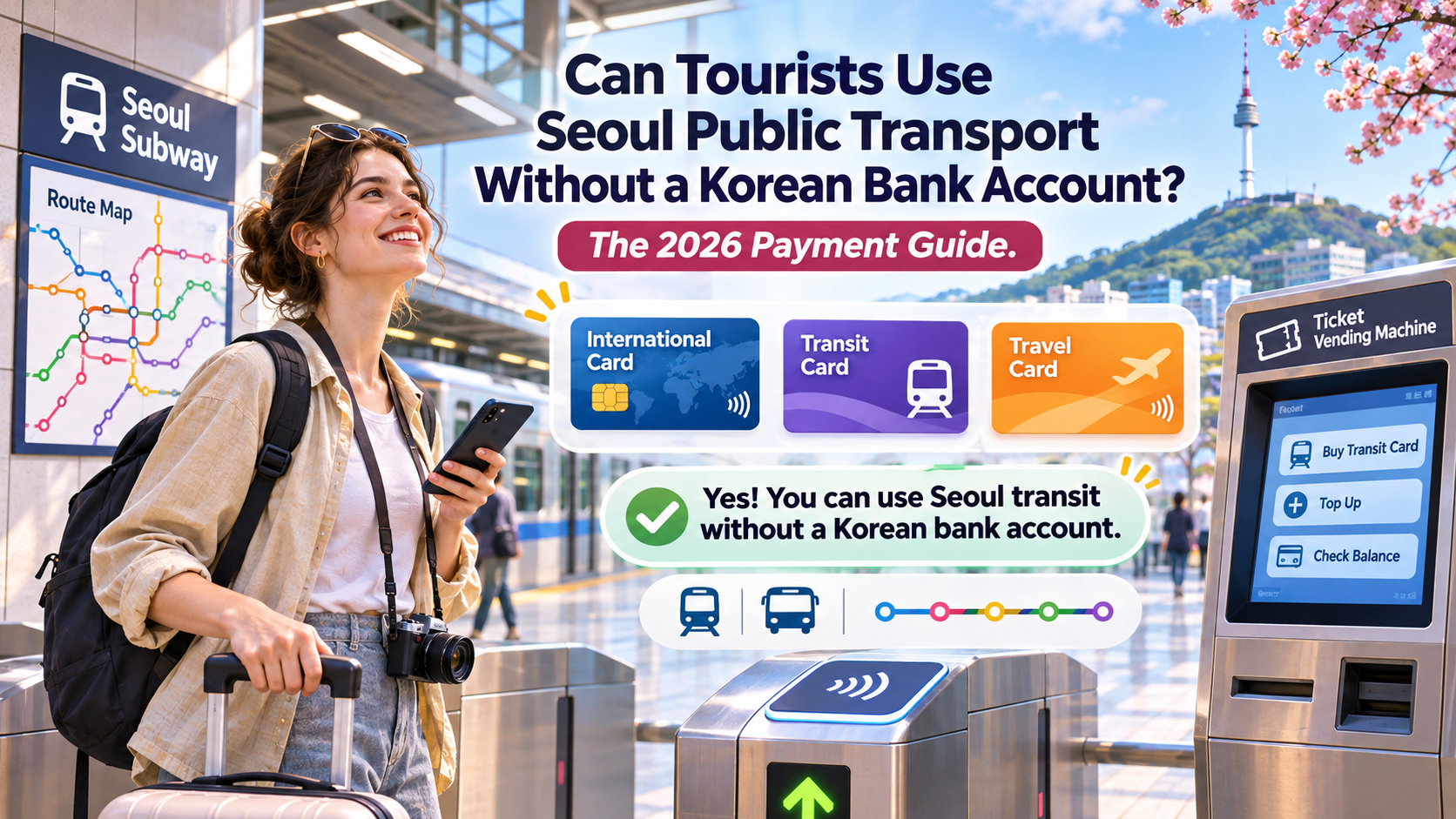
Seoul has made it easier to buy a subway ticket with a foreign credit card. That does not mean visitors can simply tap an overseas Visa or Mastercard at every subway gate. If you are travelling in South Korea without a Korean bank account, understanding that difference can prevent a surprising amount of friction on your first journey.
From March 17, 2026, Seoul began accepting internationally issued payment cards, including Visa and Mastercard, at 440 upgraded ticket machines in 273 stations on subway Lines 1–8. These machines sell single-journey tickets and support the purchase or charging of eligible short-term Climate Card passes. Seoul's March announcement puts the average service fee for an international-card transaction at approximately 3.7%. This is a ticket-machine service, not a blanket guarantee of contactless admission with your foreign bank card at the fare gate.
Quick comparison: Which option solves which problem?
- Single-journey ticket: useful when you need an occasional subway ride. At the new supported machines, an overseas card can pay for the ticket; it is not a reusable pass for buses.
- Climate Card short-term pass: a fixed-price option for repeated eligible subway and Seoul-licensed bus journeys over one, two, three, five or seven days. Coverage matters more than the label "unlimited."
- Standard Tmoney: a rechargeable transport card commonly used on eligible transit across South Korea. Conventional physical-card sales and top-ups at convenience stores and subway facilities may require Korean cash.
- WOWPASS: an international-traveller prepaid payment product that combines shopping, currency exchange and a separate Tmoney transport balance. Money held for shopping does not automatically become a subway fare balance.
These are not interchangeable financial products. Choose based on the journey you intend to take and the way you can load the transport balance, rather than assuming one card works for everything.
Option 1: One subway journey with an international card
If you have just arrived and need one subway ride, look for an upgraded machine on Seoul subway Lines 1–8. Follow the on-screen ticket purchase process, choose the destination, and pay with a supported international card. Retain the ticket for the journey and follow the machine's instructions about any deposit and return procedure.
The new machines also support foreign-card payments for short-term Climate Card products. Seoul reports that some mobile payment systems are supported as well. A station with older machines may not offer the same payment choices: look for the updated machine and displayed accepted-card information. Foreign exchange charges from your own bank, if any, are separate from the service fee stated by Seoul.
The limitation is straightforward. A single-journey subway ticket is not a bus payment card. And an accepted card at the vending machine does not establish that the same overseas card can be tapped at the turnstile directly. The safer procedure is to purchase the approved fare product first.
Option 2: Climate Card short-term passes in Seoul
Seoul's published short-term pass prices are KRW 5,000 for one day, KRW 8,000 for two days, KRW 10,000 for three days, KRW 15,000 for five days and KRW 20,000 for seven days. A new physical card costs KRW 3,000 separately. Thus a visitor buying a new physical card and a three-day pass starts at KRW 13,000 before any additional payment fees.
The important restriction is timing: a short-term pass starts on the date it is loaded, not at an arbitrary time 24 hours before the expiry. A one-day pass loaded late in the afternoon does not mean you receive a full rolling 24-hour validity period. Advance loading for a later start date is unavailable for these short-term passes.
Service limits also matter. The pass is intended for eligible subway services and Seoul-licensed buses, but excluded systems include the Sinbundang Line, GTX and airport buses. The city revised its eligible subway service area effective October 1, 2026. Always check the official route and station coverage tool before deciding that a pass will work for your route.
Airport access has a one-way exception: riders boarding within an eligible area may alight at Incheon Airport Terminal 1 or Terminal 2 on the Airport Railroad, but boarding at the airport stations under that same short-term pass is not permitted. In other words, a pass may cover an eligible trip towards the airport without covering the return trip from the airport to Seoul. Gimpo Airport Station is within the Seoul service area, subject to the rules for the eligible line and journey.
Also note the difference between Seoul's short-term Climate Card and the newer Climate Pass. The previous 30-day prepaid Climate Card recharge program ended in 2026, while the newer Climate Pass has eligibility linked to Seoul residency and its own application process. A short-term tourist should not assume that an advertisement for a monthly resident discount applies to them.
Option 3: A standard Tmoney card for a broader itinerary
A standard physical Tmoney card can be convenient if your trip crosses several regions or involves buses beyond the short-term Climate Card's service area. Korea Tourism Organization guidance describes it as a reloadable, widely accepted transport product available at convenience stores and subway facilities.
But standard purchase and recharge arrangements are distinct from the new foreign-card-capable Seoul ticket machines. The Korea Tourism Organization's May 2026 transportation guide lists foreign-issued credit cards as not accepted for conventional prepaid Tmoney purchase and top-up at the usual convenience-store and subway-station channels, with cash required there. Other services and mobile products may have different rules, so do not treat that statement as a universal ban across every Tmoney-related service.
The practical lesson: carry a modest amount of Korean cash or verify a supported top-up arrangement before reaching the gate. Likewise, check the separate ticket rules for KTX, express buses or other intercity transport: a local transit card is not necessarily the ticket for those trips.
Option 4: WOWPASS and two separate balances
WOWPASS combines a prepaid shopping payment facility and Tmoney transport functionality in a single product. It can be useful to a visitor who wants cash-exchange and retail payment convenience alongside local transportation. However, the two balances do different jobs.
A shopping balance visible in the WOWPASS app does not guarantee the card's Tmoney transport balance is sufficient. Korea Tourism Organization's 2026 WOWPASS guide describes an app function for transferring funds from the WOWPASS balance to the transportation balance. Check both before a journey. Card acquisition and recharge fees, passport identification requirements and supported payment methods can vary by service and should be checked in the official WOWPASS instructions.
Five travel situations: What would we choose?
- One or two subway rides only: compare the fare for individual tickets and the convenience of paying at the upgraded vending machine.
- Three days mainly in central Seoul: calculate likely eligible rides against the KRW 10,000 three-day short-term pass, plus any one-time physical card expense.
- A Seoul trip including excluded commuter rail or airport buses: do not assume a Climate Card covers every leg; budget for a second fare product.
- Multiple cities and frequent buses: investigate a standard transport card and its top-up method before choosing a Seoul-only unlimited pass.
- Shopping plus transport with minimal cash handling: investigate WOWPASS, but explicitly fund and verify the separate Tmoney balance.
The cheapest choice depends on the actual itinerary, not merely the number of days in Korea. This comparison is based on official published product terms; Seen in Korea has not independently tested every machine, card or foreign-bank combination.
Before you board: A three-step checklist
- Identify your stations and whether the route falls within your chosen fare product's coverage.
- Check how the product will be purchased or charged: upgraded ticket machine, cash recharge, supported app, or another explicitly documented method.
- Verify the balance or pass validity before you tap, and keep a backup payment method for any excluded journey.
The bottom line
A Korean bank account is not a universal prerequisite for taking Seoul public transportation. International-card ticket machines have removed a significant barrier, but there is still no reason to assume every foreign contactless card works directly at a fare gate or that every pass covers the same destinations. For visitors, clear route planning and a verified way to load the correct balance are more useful than one-size-fits-all promises.
Reporting cutoff: November 5, 2026 (KST). Fees, payment methods and eligible stations can change. Follow the current operator instructions when travelling.
- Seoul Metropolitan Government — foreign cards at 440 subway ticket machines, March 17, 2026
- Seoul Metropolitan Government — current Climate Card short-term rules, prices and service area
- Korea Tourism Organization — Transportation Cards
- Korea Tourism Organization — WOWPASS guide, October 2026
- KTO — May 2026 transport payment guide (PDF)