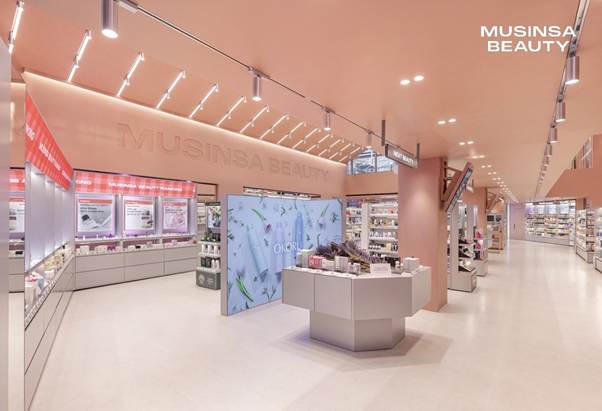
Musinsa Beauty Hongdae did more than open strongly.
In its first three days, Musinsa Beauty's first standalone beauty store and the Beauty Onnuri Pharmacy inside the building generated more than ?250 million in combined sales. The average transaction value across buyers was about ?110,000.
The more useful number is who was buying.
On the first two days, foreign shoppers accounted for about 45% of purchasing customers. By the third day, their share had climbed to nearly 60%, overtaking domestic shoppers.
Musinsa also said the purchase conversion rate among foreign visitors was about twice the level seen at its other offline stores.
That turns the store into something more useful than another K-beauty opening story.
It gives us an early look at what overseas visitors are actually buying in Korea.
Foreign shoppers were not buying the same mix
Musinsa's early sales data suggests a difference between foreign and domestic demand.
Foreign shoppers showed especially strong interest in derma and high-performance skincare brands including OGANACELL, Dr. Melaxin and Dr. Althea. Purchases were concentrated around products targeting concerns such as elasticity, lifting, eye care and acne soothing.
Domestic shoppers, by contrast, showed relatively stronger demand for color cosmetics.
That distinction matters.
"K-beauty is popular with tourists" is too broad to be useful. The better question is which categories and brands are converting after visitors walk into a Korean store.
At Musinsa Beauty Hongdae, the early signal is that international shoppers are actively searching for functional skincare, not simply picking up generic souvenirs.
The store was built for that behavior
Musinsa Beauty Hongdae opened near Hongik University Station on September 11 as the company's first standalone beauty store.
The roughly 400-pyeong space combines skincare, makeup, fragrance, hair, body and men's products across multiple floors.
The basement is different: Beauty Onnuri Pharmacy combines pharmacist consultation with beauty and wellness products under a "pharmacy beauty" concept.
That mix puts conventional beauty retail, derma-style skincare and pharmacy shopping under one roof in one of Seoul's highest-traffic tourist districts.
Musinsa is also actively courting foreign shoppers. Current store promotions include passport-based benefits, and the Hongdae location continues to run weekly beauty promotions after the launch period.
Why this matters for Seoul shopping
Olive Young has already shown that beauty retail itself can become part of the Korea travel itinerary.
Musinsa Beauty Hongdae suggests the next stage may be more segmented.
Instead of one dominant K-beauty shopping route, foreign visitors may increasingly split their spending across:
- mainstream beauty chains
- newer multi-brand discovery stores
- pharmacies
- derma and functional skincare
- color cosmetics and niche labels
That creates a much better editorial question for SEEN IN KOREA:
What are foreign visitors actually buying - and is it worth the Korean price?
What we should check next
This opening gives us a clear follow-up list.
We can compare the Korean price of the brands foreign shoppers bought most frequently against overseas prices.
We can map Musinsa Beauty Hongdae against nearby Olive Young and pharmacy stops.
And once 100 Voices interviews begin, we can ask foreign residents and travelers whether their actual shopping behavior matches the store data.
The first three days are only an early snapshot.
But they already show something useful: foreign shoppers are not just visiting Korea's newest beauty stores. They are converting at a high rate, spending meaningful amounts, and showing a different category preference from Korean buyers.