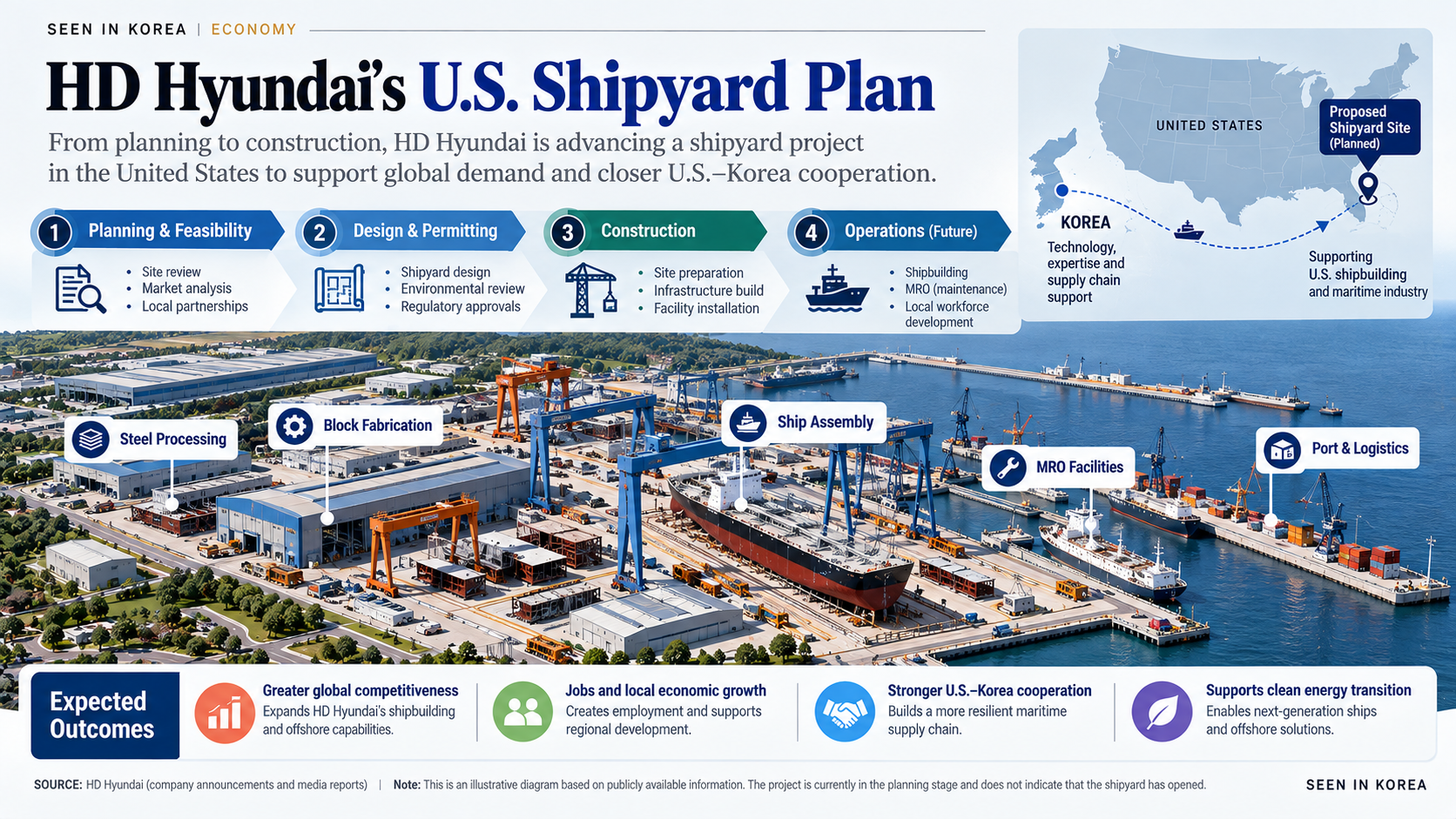
South Korea's shipbuilding industry has traditionally exported vessels from domestic yards. HD Hyundai's plan for a new US facility with American engineering and construction group Kiewit suggests another form of export: the production methods, design capabilities and supply-chain knowledge used to make ships. The distinction matters because rebuilding a yard is not the same thing as ordering a vessel built in Korea.
What happened
HD Hyundai and Kiewit announced their proposed HD Kiewit Shipbuilding joint venture on October 22, and Reuters reported the plans on October 23. Reuters added on October 28 that the partners are still evaluating the scale and structure of the US investment, with a decision targeted by year-end 2026. The company targets construction beginning in 2027 and full-scale operations in 2029; these remain target dates, not completed milestones. The project was associated with roughly 3,000 potential US jobs. Those numbers refer to project plans and estimates, not construction already completed or employment already created.
The cooperation follows previous discussions between the companies. Local reporting earlier in October described deliberations about facilities for ship blocks and large steel structures as well as the possibility of a more comprehensive shipyard. The final investment structure, commercial order volume and ultimate output should therefore be tracked through subsequent company disclosures.
The number that matters
The approximately 3,000 jobs are the most visible local economic claim, but they cannot substitute for evidence about capacity. For shipbuilding, the more consequential measurements will be assembly infrastructure, available drydock space, skilled labor, throughput, productivity and whether the facility is certified and capable of delivering target vessel types.
Why it matters in Korea
A project abroad can expand the market for Korean shipbuilding processes and marine engineering while creating a different set of commercial risks. Korean firms could earn value from designs, technologies, equipment, management and partnerships, even if some final manufacturing takes place in the United States. But technology transfer does not guarantee that every component or engineering service will be sourced from Korea.
The move also illustrates a strategic tension. More US production may deepen bilateral industrial ties, but it can also change where employment, investment and final assembly occur. Whether it is complementary to Korean yards depends on contractual terms and customer demand.
Why it matters in the United States
America has an interest in expanding domestic maritime manufacturing capacity and the workforce that supports it. A shipyard cannot be scaled simply by importing finished products: physical facilities, trained welders and engineers, suppliers, permitting and long-term orders all matter. Korean experience is relevant, but construction and workforce development take years.
The risk—and what could change
Plans may be delayed by costs, approvals, site availability or the difficulty of building a qualified labor pipeline. Military support-ship opportunities should not be treated as awarded contracts unless formally announced. Even a completed yard could require years to reach its intended productivity.
Transferring capability is a multiyear process
The productivity of a modern Korean yard reflects more than blueprints. It incorporates workforce training, fabrication sequences, supply relationships, quality-control practices and the ability to coordinate thousands of components. Transferring those methods to another country requires adaptation to local labor markets, standards and regulation. Success will depend on whether the American facility develops its own reliable industrial ecosystem rather than merely importing equipment.
This distinction is especially important for defense-related opportunities. Building commercial vessels and working on military or naval-support projects can involve different procurement, security and compliance regimes. Public discussion of possible orders is not equivalent to a contract, and the timing of any government business is beyond the shipyard announcement alone.
The broader policy objective is also different from an ordinary foreign factory expansion. The United States seeks stronger maritime industrial capabilities and a larger domestic workforce, while Korean partners seek new business opportunities and long-term market access. The eventual balance of manufacturing activity, intellectual property and employment will emerge from actual contracts and operations, not from the ceremonial signing of an agreement.
The October 28 change: orders before a final investment size
HD Hyundai's latest comments indicate that the scale of its investment will depend in part on discussions with the US government and Navy about potential workloads. That is a meaningful limit on certainty. A memorandum or joint-venture announcement can establish intent and partners without settling every financing decision. The route from a prospective naval logistics-support ship to a funded procurement contract involves separate choices by US authorities.
For readers, this also explains why investment headlines and shipyard output should not be treated as interchangeable. An industrial site, a trained workforce and a pipeline of awarded orders must all exist before production goals become realized shipments.
What we're watching
An official project location and ownership structure, financing, start of construction, orderbook commitments and verified completion milestones. This is best understood as an industrial capacity initiative, not an announcement that a US shipyard is already producing ships.