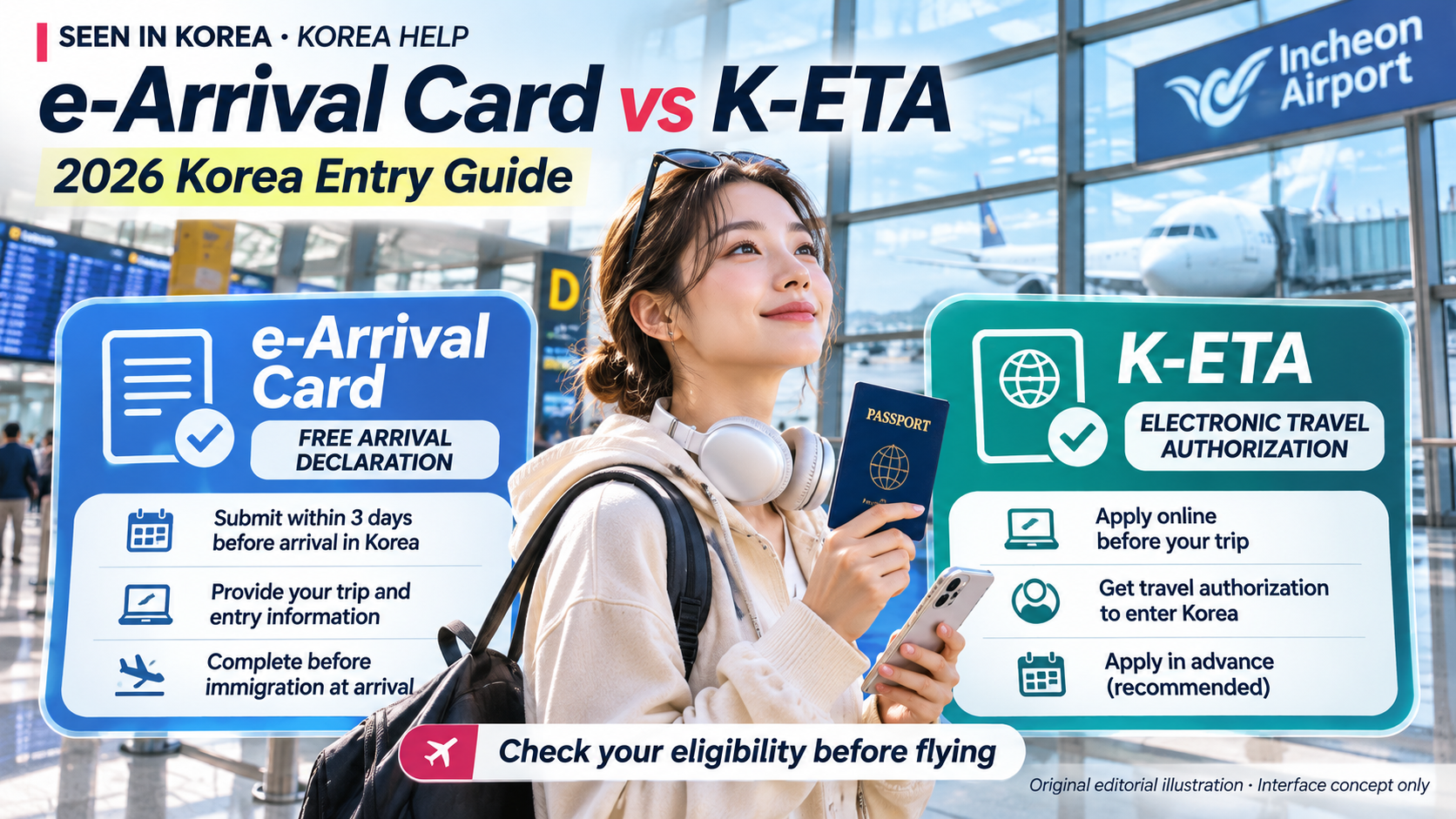
For an international traveler preparing to fly to South Korea, three documents are easily confused: a visa, K-ETA travel authorization and the electronic arrival card. They solve different problems. A visa or visa-waiver status concerns whether you can seek entry; K-ETA is a pre-travel authorization for certain eligible visa-free visitors; an e-Arrival Card is an immigration declaration. Completing one does not necessarily replace the others.
The change that matters in late 2026 is the temporary K-ETA exemption. South Korea's Ministry of Justice extended the exemption for eligible countries and regions until December 31, 2026. The policy is not a blanket exemption for everyone entering without a visa. Eligibility is determined by nationality, passport and applicable immigration rules. If you are exempt from K-ETA, you may still need to file an arrival card.
Quick decision guide: what do you need?
- You hold a valid K-ETA and will enter under that authorization: The official e-Arrival Card guidance generally exempts K-ETA holders from the arrival declaration. A special exception applies if you are entering on a visa instead.
- Your nationality qualifies for the temporary K-ETA exemption: You are not required to obtain K-ETA under that exemption, but you are generally among travelers who must submit an arrival declaration unless another exemption applies.
- You are traveling with a Korean visa: The e-Arrival Card guidance lists visa holders as a declaration category, subject to specific exceptions. A visa is not the same thing as K-ETA.
- You hold a valid Korean residence card, including relevant permanent-residence or overseas-Korean documentation: The official guidance lists these travelers among those excluded from the arrival declaration.
- You are a Korean citizen entering on a Korean passport: The e-Arrival Card is not required for you.
These are common cases, not a complete nationality-specific admissibility check. Use the official eligibility navigator and embassy or immigration guidance for unusual passports, multiple citizenships, residence statuses and special group-entry programs.
What does the 2026 K-ETA exemption actually change?
The Ministry of Justice notice dated December 23, 2025, extended the then-current temporary exemption to December 31, 2026, Korean Standard Time. The notice explains that eligible applicants see an exemption notice when their passport information page is scanned during a K-ETA application.
An exempt traveler can still choose to apply for K-ETA and pay the applicable K-ETA fee—for example, to use the benefit of not submitting an arrival card. But that optional convenience should not be confused with a mandatory payment. A person whose nationality is not covered must follow the rules actually applicable to that passport, rather than assuming all tourists are exempt.
The exemption's stated end date is important for trips spanning December and January. Do not assume a policy scheduled to expire on December 31, 2026, will continue in 2027 without a new official announcement.
How to submit the free e-Arrival Card
The government operates www.e-arrivalcard.go.kr. Its official instructions say that electronic filing is available starting three days before the date of arrival, calculated using Korean Standard Time. The form costs nothing. It replaces the paper arrival card for travelers who need to make the declaration; you do not submit both.
- Visit the official e-Arrival Card website yourself instead of following an advertisement or an unfamiliar intermediary link.
- Use the site's declaration eligibility navigator when you are unsure whether your status requires the form.
- Choose individual submission or the relevant group route. Prepare your passport, email address, flight details and address or accommodation information in Korea.
- Enter your passport and travel details as shown on your documents. Recheck spelling, dates and passport number before submission.
- Submit within the allowed time window. The website sends an issue number to your email. Keep it for reference or later edits, even though the official guide says presenting the card itself at immigration is generally unnecessary.
The government advises travelers to check or edit submissions through its official website using the issue number or email verification. Submitting an arrival card does not guarantee entry: immigration officers make the entry decision under applicable law.
Avoid a common scam: paying for a free form
The official service prominently warns about lookalike e-Arrival Card websites requesting payment information. The government e-Arrival Card is free. Do not enter credit-card details merely to file this declaration. Paid third-party travel services are not the government immigration portal. If an unfamiliar site is charging you for an e-Arrival Card, return to the official domain and start again.
K-ETA is a separate program with a separate official website, www.k-eta.go.kr. Its fee is not evidence that an e-Arrival Card should cost money.
What if you are flying in less than three days?
The three-day rule states when online filing opens—not that submission must happen exactly 72 hours before departure. Check the official portal when your arrival date enters the valid window. The site also offers paper-versus-electronic guidance. If online filing is unavailable because of an outage or an unusual status, consult the airline or immigration authorities for the applicable arrival procedure rather than buying a form from a third-party site.
Practical travel checklist
Before leaving for the airport, check your passport validity and entry eligibility, any visa or K-ETA requirement, whether you need an e-Arrival Card, your accommodation address and the airline's document requirements. Save official confirmation emails where they can be accessed without roaming data.
After arriving, the next practical tasks are usually airport transportation and getting connected. See our Incheon Airport transportation comparison and 2026 eSIM/SIM guide for those separate decisions.
Bottom line: The K-ETA exemption may remove the need for a travel authorization for eligible visitors in 2026; it does not by itself remove an arrival-declaration requirement. Check your exact status, and use the free official e-Arrival Card portal when the form applies.
Sources and verification
- Ministry of Justice K-ETA temporary exemption extension, December 23, 2025
- Government e-Arrival Card: submission guide, filing period and fee
- Government e-Arrival Card: who must declare and who is exempt
- Official e-Arrival Card portal and fake-site warning
- Official K-ETA portal
*Editorial method: Official government instructions compared as of November 17, 2026. This is general travel information, not a determination of an individual traveler's admissibility. Immigration rules may change, particularly after December 31, 2026.*