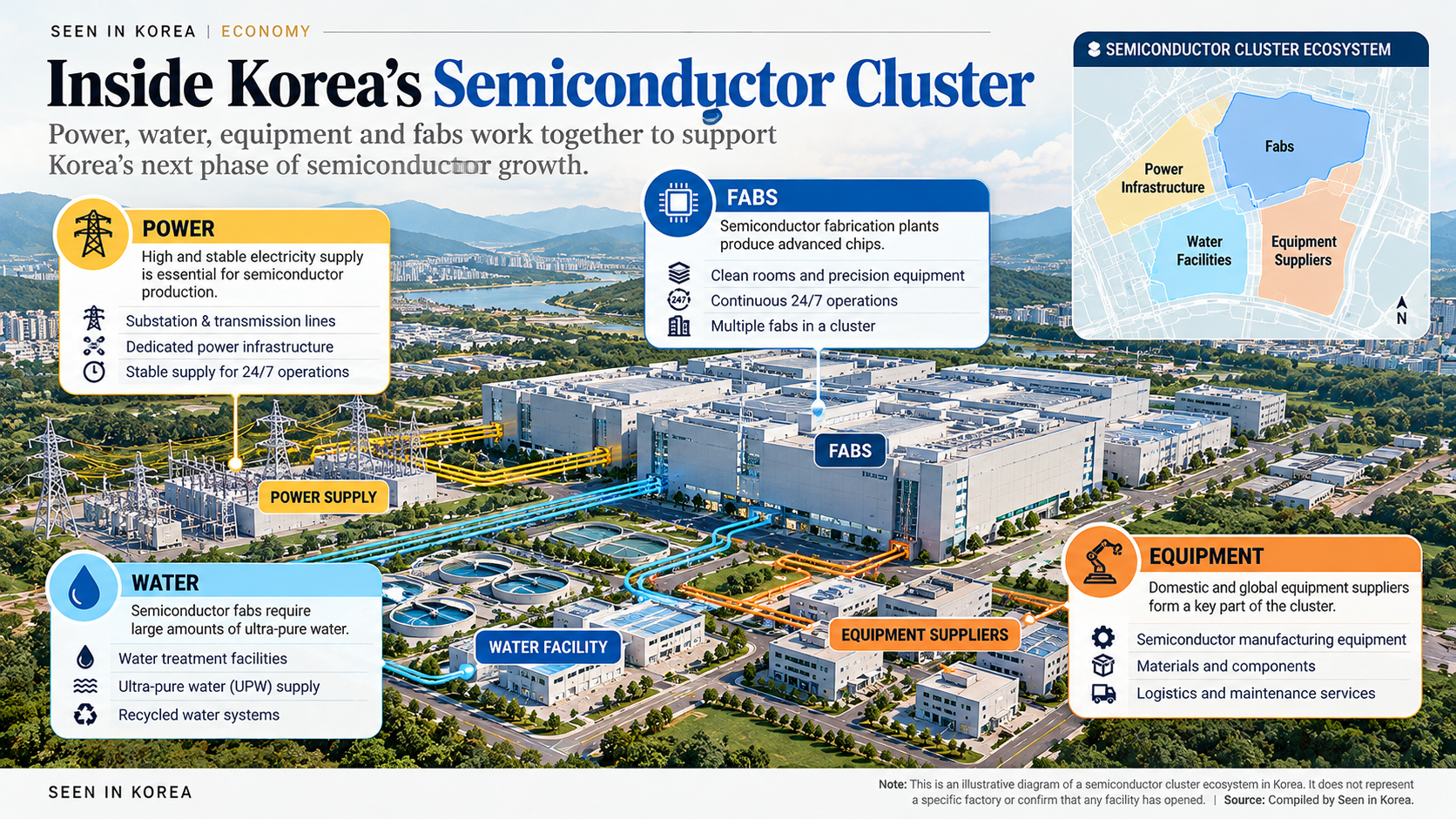
South Korea's semiconductor policy is becoming as much about infrastructure and smaller suppliers as about the country's biggest memory manufacturers. On August 10, 2026, presidential officials announced plans for a KRW 5 trillion semiconductor investment fund. The announcement is not evidence that the fund has already been fully capitalized or deployed. The policy package also included separate trade finance and a push to ensure that chip clusters have power, water and permits on time.
What happened
Reuters reported on August 10 that Presidential Chief of Staff Kang Hoon-sik outlined a new KRW 5 trillion fund focused on promising chip materials, parts, equipment and fabless companies. Officials also announced a separate KRW 5 trillion trade-finance initiative for export-oriented suppliers. The identical headline amounts do not mean this is one KRW 10 trillion investment fund; the two measures serve different purposes.
The government proposed a further ten-year KRW 1 trillion cooperation programme for collaboration between larger manufacturers and smaller suppliers. These figures describe policy commitments or planned financial mechanisms, not immediate disbursements to specific companies.
The number that matters
Two physical resource targets help explain the strategy. Officials described plans to provide 650,000 metric tonnes of water daily by 2030 for semiconductor projects in the southwestern region, and 14.7 gigawatts of electricity for the Yongin cluster by 2041. Both are future supply plans, subject to implementation, not evidence that all utilities are already connected.
Why it matters in Korea
Chip fabrication is a networked industry. A leading-edge factory cannot operate efficiently without specialized chemicals, precision components, production equipment, software design expertise and steady utilities. Building the most advanced manufacturing lines may create demand for local suppliers, but only if the supplier ecosystem can meet quality, financing and delivery requirements.
Electricity and water are not peripheral considerations. Fabrication facilities consume power at scale and need highly controlled water supplies. Delays in transmission, water infrastructure or environmental approvals can limit how fast an otherwise funded facility reaches full output. Funding mechanisms can address some financial constraints but cannot automatically resolve an engineering or permitting bottleneck.
Why this matters outside Korea
The global technology industry relies on Korean memory manufacturing. If the industrial base expands successfully, suppliers of equipment, materials and downstream electronics may benefit from more capable and resilient supply chains. But concentration in one geography remains a potential vulnerability to energy shortages or other interruptions.
The strategy also illustrates how industrial policy is shifting from direct support for headline champions to the surrounding ecosystem. It is not proof that every funded supplier will become globally competitive.
The risk—and what could change
Legislation intended to speed approvals must pass through the political process. Power and water projects require long construction horizons and local coordination. Fund performance depends on deployment discipline and commercial outcomes. Announcements alone do not establish that the spending has been executed or that every target will be met.
Industrial funding cannot replace execution
An investment fund can help specialized suppliers finance research, production tools and commercial expansion. But funding is only one input into a successful semiconductor ecosystem. Suppliers must qualify products through rigorous testing, satisfy demanding reliability standards, retain skilled engineers and build relationships with manufacturers whose production lines cannot tolerate defects. Supporting firms before they achieve commercial scale may be valuable, but outcomes will differ from one recipient to another.
Power supply has its own implementation chain. Electricity must be generated, transported through adequate transmission networks and delivered at stable quality to factories operating continuously. Announcing a future gigawatt figure is therefore a starting condition for planning, not proof that permits, grid connections and generation are already in place. Water has a comparable set of constraints involving sourcing, purification, treatment and environmental standards.
An additional question is whether public support crowds in private investment or merely substitutes for spending that would have happened anyway. Evaluating the fund requires public evidence on who received financing, the investment terms, follow-on private capital and measurable results. It would be premature to declare the programme successful solely because a large amount was announced.
The announcement is not the same as a funded project
The August measures include a proposed semiconductor fund, separate trade finance and a cooperation programme. They may be implemented by different public and private institutions, on different schedules and through different types of financing. A reported project becoming eligible for support does not prove it has received financing, and an announced target for power or water is not an operational utility connection. Those are distinct milestones readers should expect future government disclosures to identify.
This also matters for measuring industrial productivity. A supplier receiving a loan is an input; a qualified component that cuts fabrication costs or improves reliability is an outcome. Assessing success therefore requires evidence on investment deployment, commercial production, supplier revenue and the timeline for infrastructure delivery.
What we're watching
Formal fund launch documents, project-level investments, progress on the proposed special-zone legislation, grid milestones for Yongin and water-supply construction. The strongest measure of success will be verified operating capacity and supplier productivity, not only the size of the announced fund.