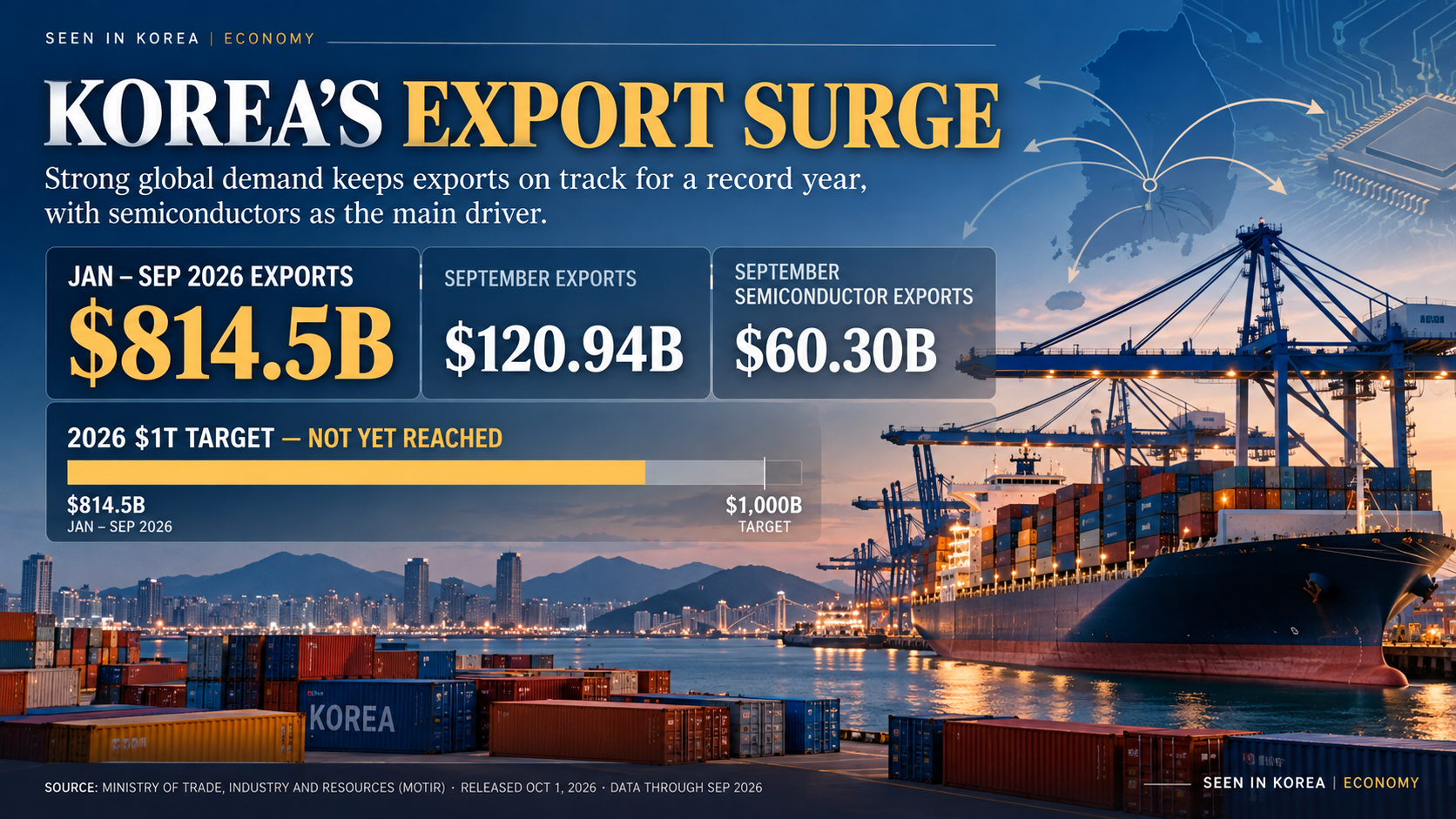
South Korea is approaching a milestone few export economies have reached: $1 trillion in annual merchandise shipments. The important word is approaching. Official trade statistics released on October 1 show exports totaling $814.5 billion in January–September 2026. That is a completed nine-month result, not the full-year figure.
The number that matters
The Ministry of Trade, Industry and Resources reported September exports of $120.94 billion, up 83.5% from a year earlier, and imports of $71.09 billion. The monthly merchandise trade surplus was $49.85 billion. Cumulative exports through September exceeded the previous full-year record cited by the ministry, $709.3 billion for 2025. These are customs-based trade values measured in US dollars.
To reach $1 trillion, exporters would need about $185.5 billion more over October–December—an arithmetic threshold, not an official forecast. The record September pace indicates the milestone is within reach, but three remaining months cannot be assumed to repeat it.
The hidden concentration
September semiconductor exports jumped 263% year on year, compared with growth of 23% for non-semiconductor goods, according to the ministry. The unusually large difference suggests chips are contributing disproportionately to the headline expansion. It does not mean non-chip exporters are shrinking, and it does not mean all shipments are solely AI-related. Trade partners, product classifications and price movements remain essential to understanding the data.
The comparison is also influenced by the earlier-year base. Very high percentage increases should be read alongside absolute export values and recent price shifts. Monthly shipments can be volatile, particularly in a business with periodic contract repricing and equipment investment cycles.
Why it matters in Korea
Exports affect manufacturing output, corporate profits, supplier investment and Korea's external balance. But a record trade total does not automatically lift domestic consumption, distribute earnings evenly, or guarantee sustained growth next year. A concentration in chips can amplify success during an AI infrastructure boom while exposing national performance to a reversal in orders or memory pricing.
Why it matters globally
Korea supplies essential components to technology firms assembling servers, computers and smartphones around the world. Its export figures therefore help show where supply-chain spending is going. They also remind global buyers that concentration risk can exist on both sides of the transaction: in the demand for AI computing and in the specialized suppliers serving that demand.
The risk—and what could change
Demand from large overseas technology companies could slow; semiconductor prices could weaken; exchange rates and energy-import costs could affect Korea's trade balance. Export values should also be separated from value-added GDP and company cash flow.
How to read a trillion-dollar milestone
Export statistics refer to the declared value of goods crossing borders. They are not equivalent to foreign demand for Korean services, direct investment flowing into the country, or the net income ultimately retained by Korean corporations. A trade surplus also reflects imports; it can rise when exports surge, when imports weaken, or when both change. September's large monthly surplus should therefore be analyzed alongside the import figure and trends in domestic spending.
There is an additional distinction between the value and the volume of goods. Higher memory-chip prices can raise dollar export revenue even if the number of units shipped changes by less. A strong dollar-denominated trade figure may also not translate linearly into inflation-adjusted economic production. Readers should compare export values with price indices and actual industrial output to assess what has changed.
The final quarter introduces a timing question. If semiconductor buyers bring shipments forward, part of a record month could reflect orders that would otherwise arrive later. Equally, holiday-related production schedules can produce unusual monthly fluctuations. The sensible benchmark is not whether one spectacular September persists indefinitely, but whether the full-year number is supported by a diversified mix of products and buyers.
What would the remaining quarter have to deliver?
Simple arithmetic places the remaining distance to a $1 trillion annual total at $185.5 billion after September. That is a threshold calculation, not an October-to-December export forecast. The outcome will depend on actual customs shipments in the final three months, and it could change even if the semiconductor boom remains strong. Export values also move with selling prices; a rapid increase in memory-chip prices can raise reported dollar totals faster than physical units.
The distribution of the gains matters. Rising electronics shipments may lift factory investment and national income, but companies exposed to the domestic consumer or to weaker overseas product categories need not enjoy the same conditions. Trade volumes, unit prices, destination markets and non-chip exports are the next data points needed to judge whether a new record marks diversification or a narrower export surge.
What we're watching
October through December customs releases; semiconductors' share of total export value; the breadth of growth outside chips; and whether a $1 trillion figure is actually recorded rather than forecast. The milestone would matter most if it were followed by a more diversified, durable export base.