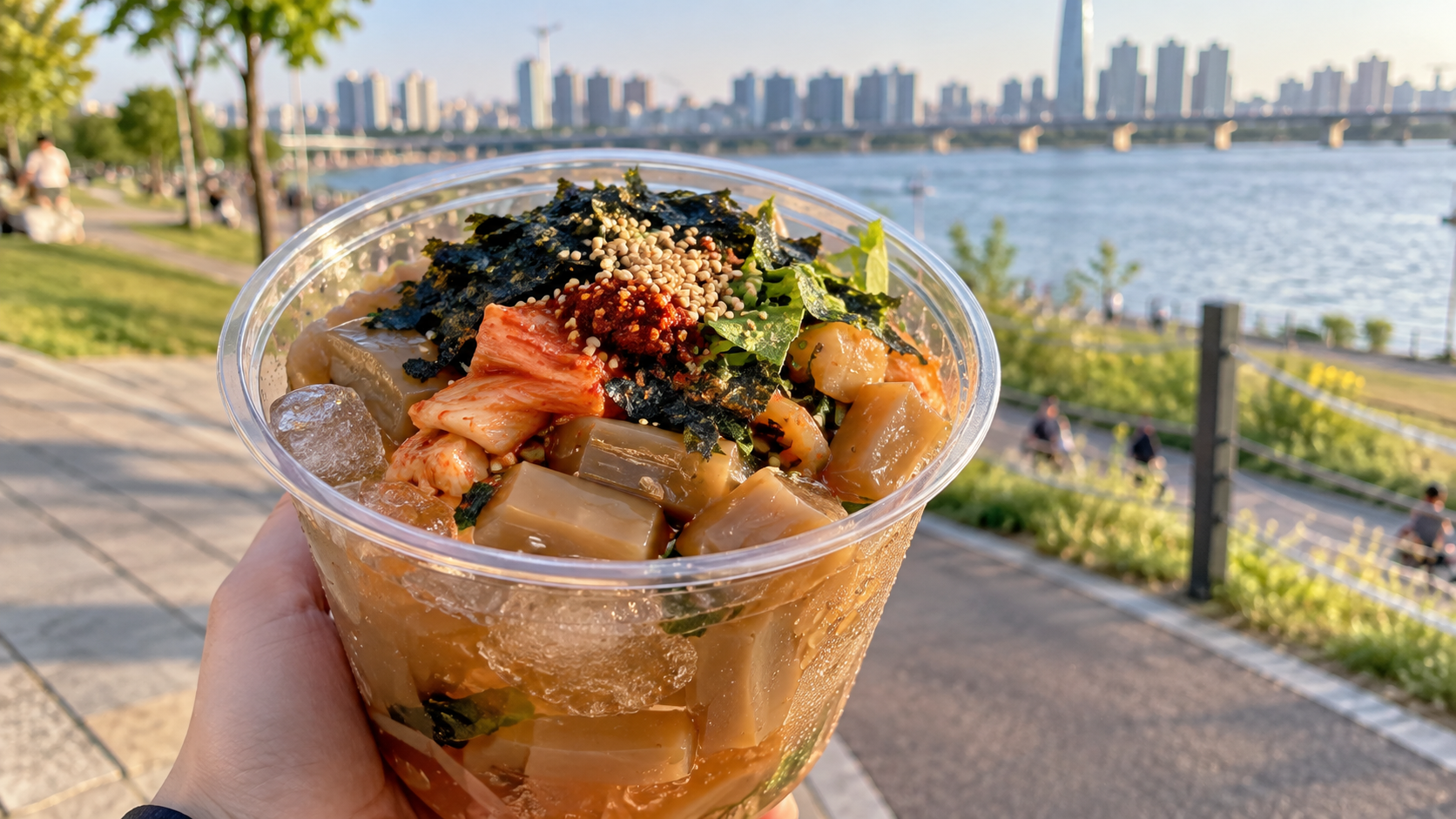
One of Korea's most traditional-looking foods is being repackaged for a younger, faster audience.
In Seoul's Mangwon area, "cup mukbap" ??a portable serving built around dotorimuk, or acorn jelly ??is drawing young customers who eat it on the go, after exercise or on trips to the nearby Han River.
The unusual part is not the ingredient.
It is the format.
By the numbers
46 calories. Approximate calories per 100 grams of acorn jelly, based on restaurant nutrition data cited from Korea's Ministry of Food and Drug Safety
20s and 30s. The age group highlighted in recent reporting as driving lines at a Mangwon specialty shop
What is dotorimuk?
Dotorimuk is jelly made from acorn starch.
Raw acorns contain tannins that create a strong bitter, astringent taste, so traditional preparation involves soaking and processing the acorns before extracting starch.
The starch is cooked with water and cooled until it becomes a soft, springy jelly.
In Korea, dotorimuk has long appeared as a side dish or as part of rustic meals.
The new twist is portability.
Why cup mukbap works
Putting the jelly into a grab-and-go cup changes the context.
Instead of sitting down for a traditional meal, customers can carry it to Mangwon Hangang Park, eat it after a run or treat it as a light meal.
That fits several current food trends at once:
traditional ingredients, lower-calorie positioning, convenience and social-media-friendly presentation.
Is it actually a health food?
The calorie number is real, but the finished cup is more than plain acorn jelly.
Rice, broth, seasoning and toppings change the total nutrition.
So describing every cup mukbap as "46 calories" would be misleading.
The 46-calorie figure applies to approximately 100 grams of acorn jelly itself, not necessarily the full ready-to-eat cup.
Why foreign visitors should know it
Many visitors know tteokbokki, hotteok and Korean fried chicken before they arrive.
Dotorimuk is different.
It is a familiar Korean ingredient being reintroduced through a format that looks contemporary.
For SEEN IN KOREA, that makes it a better story than simply calling it the next viral food.
It shows how younger Koreans are changing the way traditional foods are eaten.