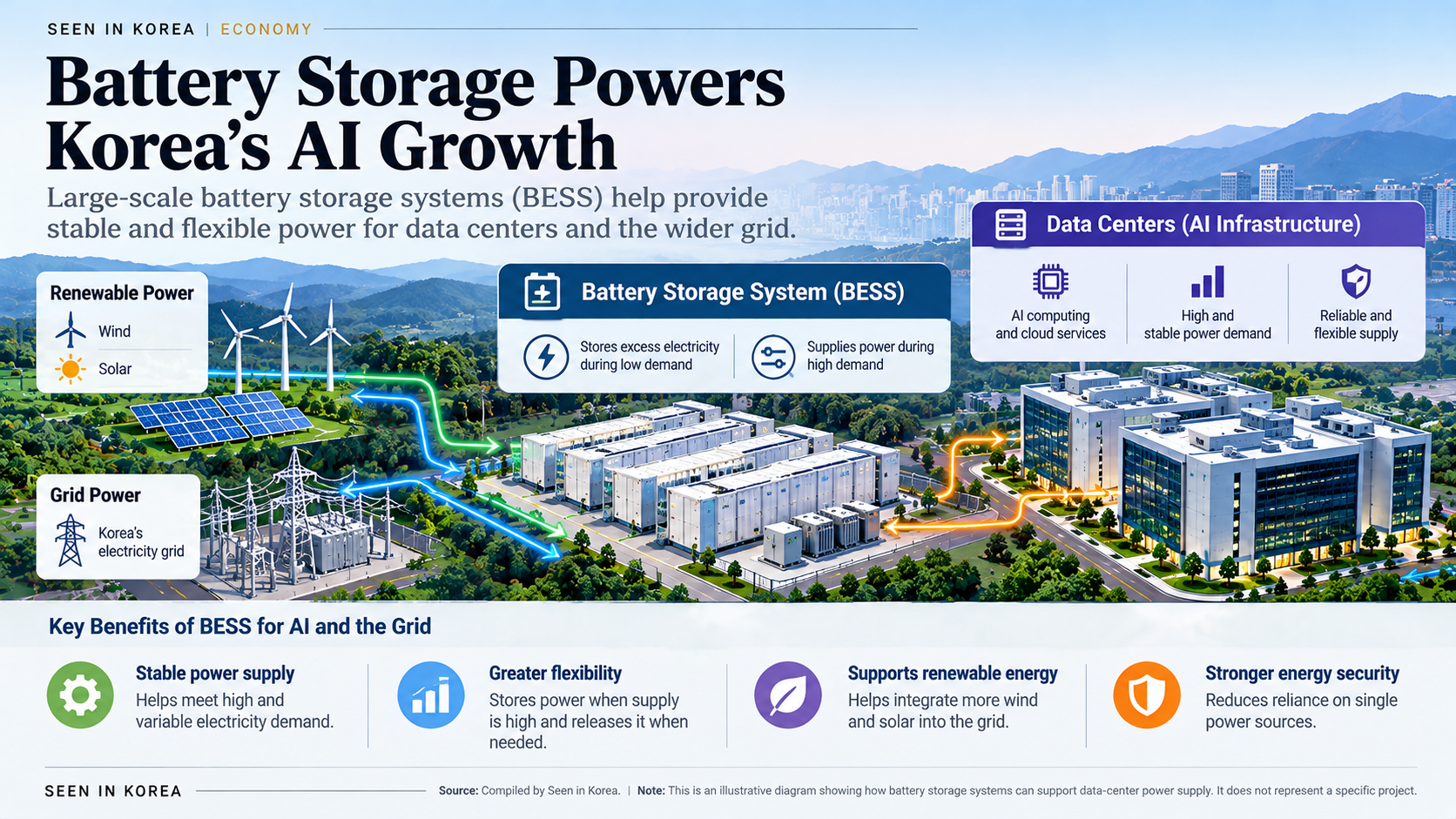
LG Energy Solution is increasingly presenting itself as more than an electric-vehicle battery supplier. Its energy storage system, or ESS, business is expanding into large projects tied to electricity networks and power-hungry infrastructure, including data centers. That creates a potential link to the AI boom, but the size and timing of future revenue need to be measured carefully.
What happened
In its July 30 second-quarter release, the company said ESS revenue during the first half of 2026 was 4.6 times the year-earlier level. It reported more than KRW 3 trillion of new ESS orders during the period, including AI data-center-related demand. ESS's share of company revenue had expanded into the upper-20% range according to that release. These are company-reported measurements for a defined period; they should not be projected into a full year without additional evidence.
On October 27, LG Energy Solution announced a non-binding strategic memorandum with Energix Renewable Energies. The companies intend to pursue about 1.5 GWh of European ESS supply and 0.5 GWh in North America over 24 months, with discussions of possible expansion to 4.5 GWh. This is a cooperation target, not an executed supply contract or recognized revenue.
LG also said in July that it expected to secure over 50 gigawatt-hours of annual North American ESS manufacturing capacity by year-end, supported by production changes at joint-venture facilities. That is a target as reported in July, not confirmation that all the capacity was already operating.
The number that matters
LG's preliminary third-quarter results announced October 8 showed group revenue of KRW 9.6434 trillion and operating profit of KRW 756 billion. Those are consolidated company figures, not standalone ESS revenue. The company disclosed KRW 416.9 billion of advanced manufacturing production-related tax credits included in the period's results. Excluding the disclosed credit, operating profit was KRW 339.1 billion. This distinction is essential when assessing underlying operations.
Why it matters in Korea
The EV market and grid storage market have different customers and purchasing cycles. EV battery demand depends heavily on automaker production and consumer adoption. ESS demand can come from utilities, renewable-energy projects, grid operators and commercial facilities seeking flexible electricity capacity. Diversification can lower reliance on one end market, but it does not remove battery pricing, cost and execution risk.
Why it matters outside Korea
AI data centers need reliable electricity, but batteries do not generate energy. They store power and can help balance short-duration demand, support backup configurations and integrate variable electricity sources when designed appropriately. That makes ESS one part of a broader power-system investment story involving generation, transmission, grid connection and load management.
North American production capability may matter for local customers concerned with delivery, sourcing and policy rules. However, production capacity is a ceiling or target rather than proof of realized deliveries or margins.
The risk—and what could change
Orders are not equivalent to immediate revenue, and capacity targets can shift. Policy incentives, project approvals, safety standards, cell pricing and competition all affect future profitability. EV demand could recover faster than expected or ESS projects could face grid bottlenecks.
The difference between a battery plant and grid reliability
An ESS project includes far more than cells. Inverters, control software, thermal-management systems, safety protection and grid-interconnection approvals are needed before energy can be stored and delivered reliably. The size of a factory in gigawatt-hours describes a potential annual cell-production quantity, not how much electricity a connected project can deliver at a given moment. Megawatts describe power; megawatt-hours describe stored energy. Confusing those units can inflate the perceived benefit of a new production line.
AI data centers create demand for robust electrical systems, but a storage installation does not solve a missing transmission line or an inadequate supply of generation on its own. Depending on design, batteries may help shift consumption over time or support specific backup requirements. Whether the economics work depends on electricity tariffs, duty cycles, warranties and the value of reliability at a particular site.
There is also a financial timing gap. An order can cover equipment scheduled for delivery well into the future. A contract does not establish when the company recognizes revenue, collects cash or earns profit. The most important future evidence will be completed deliveries and the margin they generate after manufacturing and installation costs.
A fresh example of the pipeline-versus-contract distinction
The October 27 Energix memorandum is useful precisely because its status is explicit. The announced 2 GWh collaboration objective identifies potential markets and scale, while the possible 4.5 GWh expansion is an option under discussion. Neither is a binding purchase order in the release. A subsequent executed agreement, confirmed delivery schedule or reported revenue would provide stronger evidence of commercial conversion.
For global electricity developers, the relevant question is also whether the battery installation serves a connected renewable project, a stand-alone grid asset or an AI data-center customer. Those use cases have different operating profiles and economics. LG's broader ESS opportunity spans all of them, but no single announcement establishes the performance of the entire segment.
What we're watching
Quarterly ESS revenue disclosures, order conversion into shipments, North American plant utilization and the contribution of government incentives to earnings. The most useful test is whether ESS produces durable margins, not simply a larger order backlog.