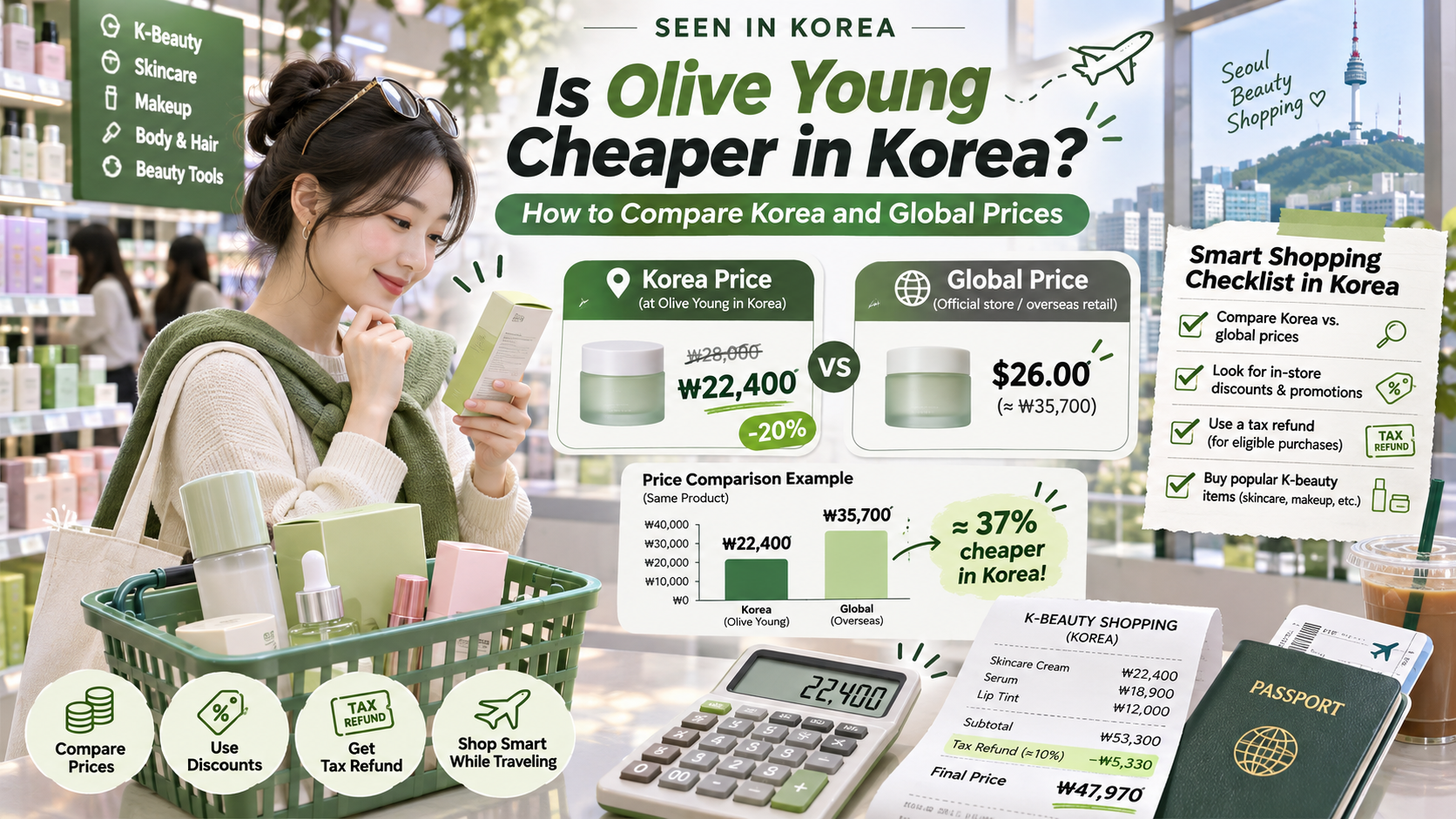
A product can look cheaper on a Korean beauty-store shelf than on an international shopping website and still be the more expensive choice once you consider your location, shipping, exchange rates and import fees. The reverse can also happen when a promotional global set includes gifts or a shipping discount.
Rather than publishing a sensational claim that Korea is always '40% cheaper,' this guide explains a transparent method for comparing Olive Young Korea and Olive Young Global. Seen in Korea has not completed a synchronized, same-day basket purchase or verified a ten-product price dataset for this report; percentages that imply such a test are intentionally excluded.
First check that you are comparing the same thing
A Korean retail listing and an international listing may have similar product names but different quantities: a single serum bottle versus a two-pack, a standard moisturizer versus a jumbo size, or a gift set with extra samples. A price comparison is meaningless unless you match the brand, product line, volume, formula and set contents.
The minimum evidence is a product code or an unambiguous combination of variant, shade, size and quantity. Photos alone are insufficient when packaging changes by market.
Separate the five components of the price
- Product subtotal: the current, actually purchasable price for the exact matching product in each region.
- Promotions: coupons, memberships, app-exclusive rates, bundles and eligibility limits. An advertised first-order offer is not universal.
- Currency conversion: use a dated exchange rate and consider the card issuer's actual foreign transaction fee.
- Shipping: Olive Young Global publishes country-specific free-shipping thresholds and estimated delivery windows; eligibility varies by destination.
- Taxes and customs: the global store explicitly warns that import VAT, duties or local handling charges can apply and that responsibility depends on the destination.
Because the global website ships from South Korea to many countries, a shopper overseas is not simply comparing two retail sticker prices. They are comparing landed costs.
An illustrative comparison—not measured market data
Imagine that the same 50 mL cream costs ₩20,000 in Seoul. A global listing has a different currency price which converts to ₩24,000. At face value the global listing is 20% higher. But if traveling to a Korean store requires transport, or if global shipping is already free on a larger order, the final decision depends on the full basket.
These are invented numbers to illustrate arithmetic, not an Olive Young quote or a record of an actual purchase. The purpose is the method: total all relevant charges for each option using values checked at the same time.
Comparison formula: effective total = product subtotal – eligible discount + shipping + import tax/fees + card conversion costs. Divide the final total by usable units or milliliters if pack sizes differ.
What Olive Young itself confirms
The company's official Global Mall shipping page says goods are shipped directly from Korea to international destinations. It publishes delivery estimates and shipping thresholds by country, and cautions that taxes and duties may be paid during checkout or on delivery depending on destination. The site also warns that product prices and shipping charges do not necessarily include customs duties.
That is why a US shipping threshold cannot automatically be applied to Japan, Taiwan, Canada or a European market. It also means a Korean in-store tax-refund opportunity, where available and legally eligible, is a separate question from global e-commerce shipping.
Practical options for three shoppers
Visiting Seoul soon: compare the exact store's price and stock with your desired shopping list. Factor in time, baggage allowance, cosmetics import restrictions at home and any legally available tourist tax refund. Do not count a refund before confirming store participation and eligibility.
Living overseas without travel plans: compare your landed cost on Olive Young Global with authorized local sellers, remembering that different distributors can offer different promotions and shipping arrangements. Authenticity and return policy are part of value.
Shopping as a group: calculate whether a shared order legitimately meets the free-shipping threshold and whether extra import duties cancel the savings. Do not split customs declarations improperly to claim benefits.
Six errors that make online comparisons unreliable
- Comparing sale prices from different dates.
- Comparing a one-pack to a discounted bundle.
- Omitting shipping, customs or local taxes.
- Ignoring store-only coupons or membership requirements.
- Using an exchange rate without a timestamp.
- Assuming every offline branch has identical price and stock.
A good comparison article should publish the checked date, destination, exact SKUs, rate source and screenshots. Until that evidence exists, a firm ranking of 'Korea always wins' would be speculation.
A more trustworthy way to choose
Build a small table before purchasing: exact item / pack size / local list price / global checkout price / shipping / customs estimate / cancellation and return conditions. Refresh the numbers at checkout, not from a months-old blog post. Use the official Olive Young Global shipping terms as a starting point.
Bottom line: Olive Young Korea may be less expensive for some products, but the size and even direction of the difference depend on the exact product and total cost. A dated, reproducible basket comparison is more useful than a blanket percentage claim.