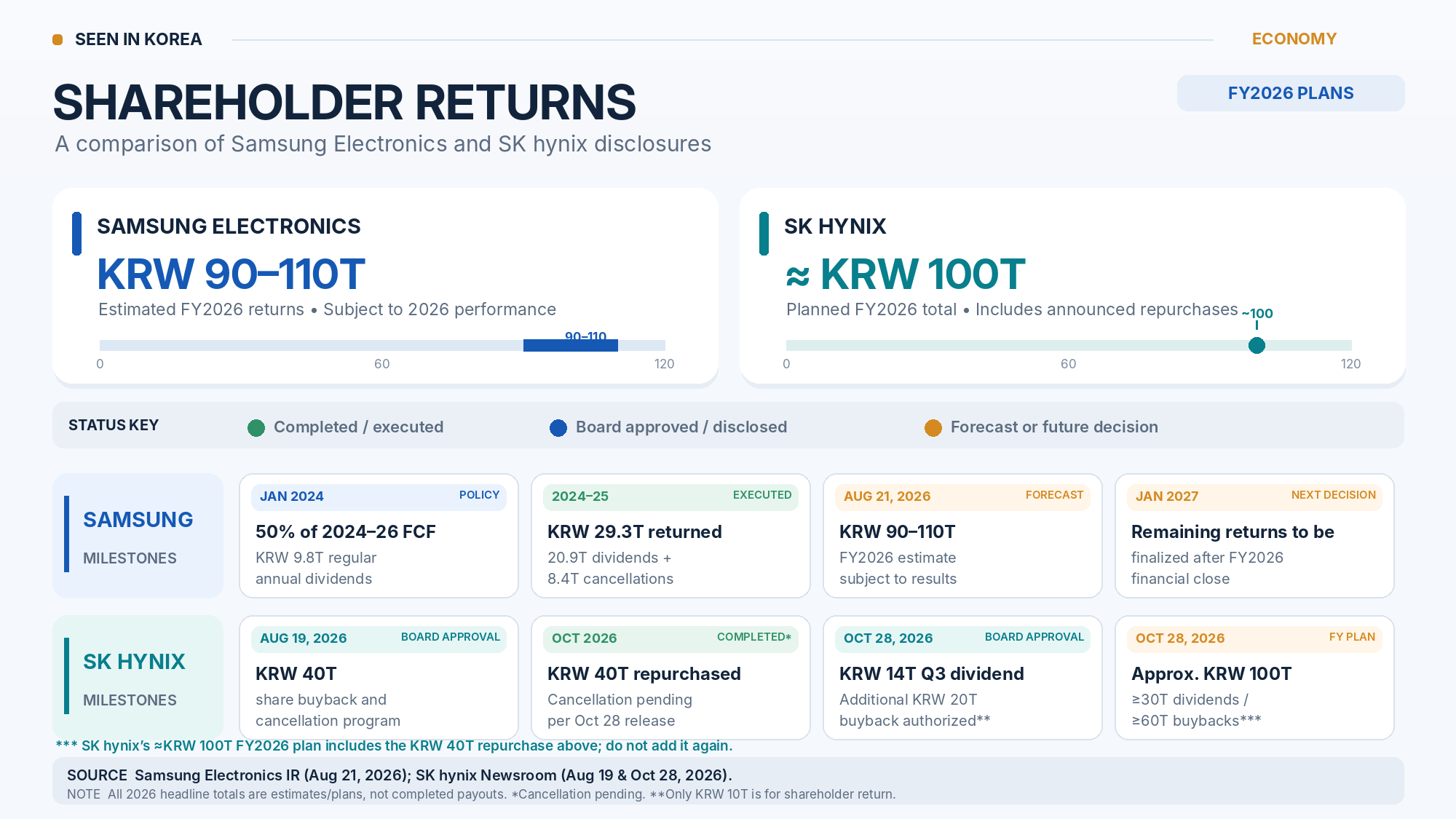
South Korea's two leading memory-chip manufacturers are promising extraordinary shareholder returns during an artificial-intelligence-driven profit boom. On October 28, SK hynix announced a shareholder-return plan of approximately KRW 100 trillion for fiscal 2026. Samsung Electronics had already estimated KRW 90 trillion to KRW 110 trillion for the same year. Together, the headline amounts imply roughly KRW 190 trillion to KRW 210 trillion in planned or estimated returns. That is an aggregation of separate company statements, not a single audited payout and not money already delivered to investors.
What happened
SK hynix's October 28 corporate release says its 2026 plan comprises at least KRW 30 trillion in cash dividends and at least KRW 60 trillion in repurchases and cancellations, with the total around KRW 100 trillion. This includes a KRW 40 trillion repurchase approved in August and completed last week, with cancellation of those shares expected shortly. The company also approved a third-quarter cash dividend totaling KRW 14 trillion and an additional KRW 20 trillion repurchase. Of the newly authorized KRW 20 trillion, approximately KRW 10 trillion is intended for cancellation and shareholder returns, while about KRW 10 trillion is for employee compensation and is excluded from the shareholder-return total.
Samsung's August 21 statement estimated 2026 shareholder returns at KRW 90 trillion to KRW 110 trillion. It expected approximately KRW 30 trillion in third-quarter dividends, subject to a later board decision, and said the remaining arrangements would be settled after full-year results at a January 2027 board meeting. Samsung also approved a separate repurchase of approximately KRW 15 trillion for employee compensation. It would be wrong to count every compensation-related purchase as shares permanently removed from circulation.
The number that matters
KRW 190 trillion to KRW 210 trillion is the combined indicative scale: Samsung's KRW 90–110 trillion estimate plus SK hynix's roughly KRW 100 trillion plan. The components have different approval, execution and payment dates. Some SK hynix buybacks have already been executed; other transactions and dividends are planned. Samsung's full-year total remains an estimate tied to later earnings and decisions.
This distinction is more than accounting language. Dividends transfer cash to holders on the applicable record dates. A repurchase changes the ownership of shares; cancellation changes the permanent share count. Shares later distributed to employees may not have the same effect as shares retired for all remaining holders.
Why it matters in Korea
The 'Korea discount' is shorthand for concerns that Korean equities can trade below international peers partly because of governance, ownership structures, capital allocation and minority-shareholder protections. A powerful AI chip cycle can improve cash generation without resolving all of those concerns. In fact, a windfall can make the governance question more urgent: who decides how much is returned, how it is returned, and on what timetable?
The company's ability to fund research and additional fabrication capacity remains essential. Distributing all available cash would not automatically be prudent for a capital-intensive semiconductor manufacturer. The issue is whether boards explain trade-offs clearly, commit to fair treatment across shareholders and follow through on announced policies.
Why this matters outside Korea
International institutions hold Korean semiconductor exposure directly and through indices. Investors evaluate not only memory prices and profit margins but also whether the governance framework converts earnings into predictable economic rights. The same decisions affect global chip supply: capital spent on new fabrication facilities and packaging capacity influences future memory availability, while dividends and cancellations alter the return profile for shareholders.
SK hynix said its third-quarter operating profit reached KRW 83.3338 trillion and attributed much of its financial strength to demand for advanced memory. This is company-reported preliminary earnings information; the strength of one quarter should not be extrapolated into an indefinite cycle.
The risk — and what could change
Memory prices, spending by large AI customers and major construction projects can all change the cash available for future distributions. The amount, timing and mechanics of individual payments may therefore differ from the initial full-year headlines. Samsung is due to detail parts of its third-quarter return at an October board meeting, and SK hynix will need to implement the remaining measures under its announced plan.
Governance assessments should remain distinct from stock-price predictions. Larger payouts may address a genuine investor complaint but do not guarantee a particular valuation multiple or end concerns about related-party transactions, voting rights and board oversight.
How to measure whether the promised returns actually happen
The most reliable scorecard separates four lines: cash dividends declared and paid; repurchases announced and completed; treasury shares actually cancelled; and shares purchased for employee compensation. A single large 'returns' figure obscures these differences. Analysts should also compare the distributions with free cash flow rather than treating net accounting profit as fully distributable cash.
A separate question is durability. Samsung and SK hynix operate in cyclical markets where contract prices, capacity additions and product transitions change quickly. Current plans may reflect extraordinary profits and investment gains, including SK hynix's disclosed gains related to Kioxia. A one-time special distribution should not be confused with a new permanent annual baseline.
What we're watching
The publication of final Samsung dividend terms, subsequent SK hynix buyback cancellations, actual payments, future capital-expenditure plans and any board reforms that make allocation decisions more transparent. The verified story is the unprecedented planned scale of shareholder returns; whether it narrows the Korea discount will require evidence beyond the announcement.