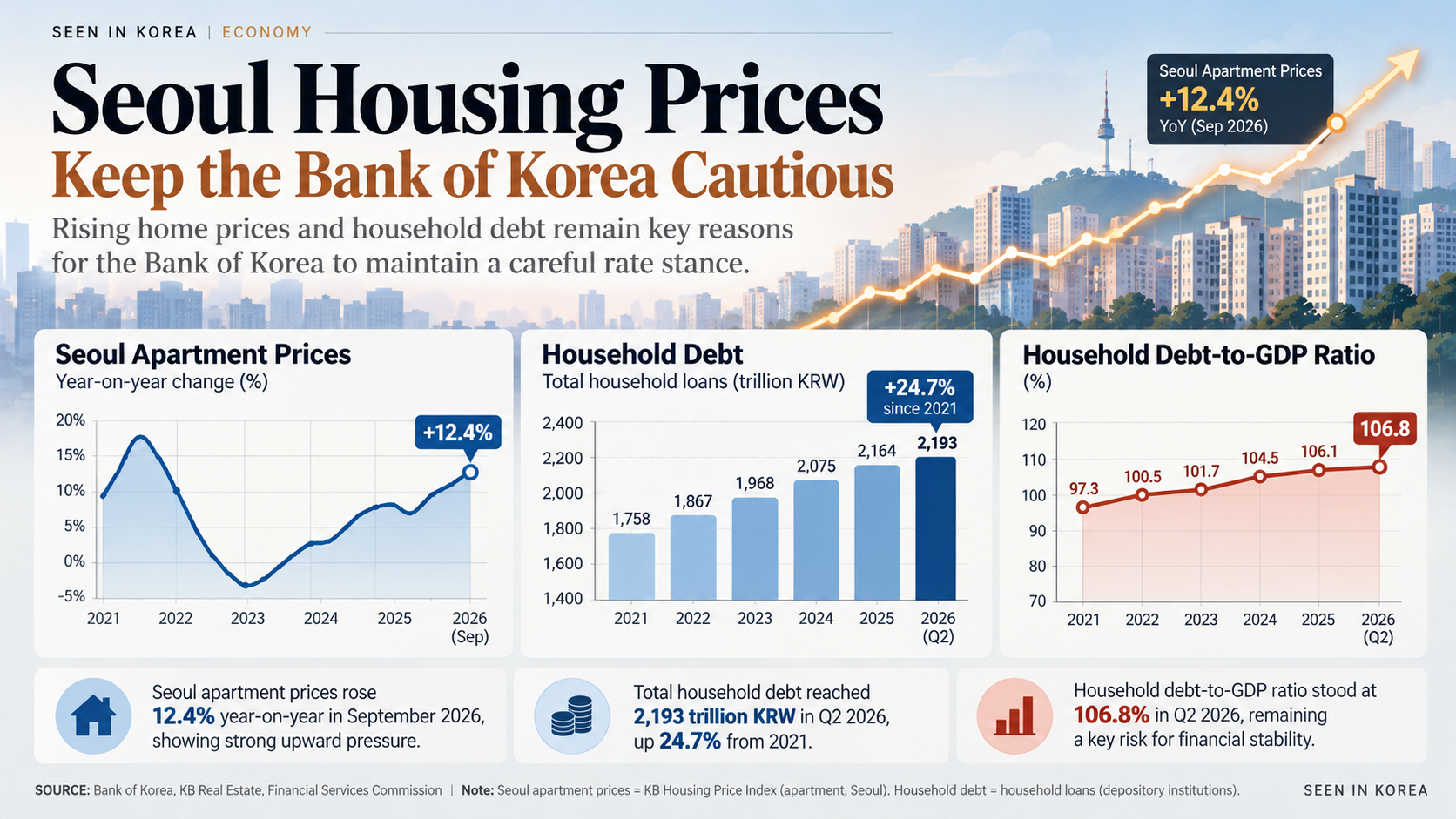
Seoul's housing market is one reason the Bank of Korea cannot set interest rates using inflation and GDP alone. In its October 22, 2026 monetary policy statement, the central bank highlighted accelerating home prices in Seoul and parts of the surrounding region and continued increases in housing-related loans. Those trends persisted even as total household loans declined during the period described by the bank.
What happened
The BOK unanimously held its Base Rate at 3.00% on October 22. Its statement identified strong export-led economic growth, inflation around 3%, uncertain external developments and financial-stability risks as competing considerations. The bank also said it needed time to assess the effects of two previous increases in the policy rate. The housing market was one component of that decision, not the only one.
The number that matters
Three percent is the policy benchmark, not a uniform mortgage interest rate. Housing loans have their own pricing and risk controls. More importantly, the direction of total household lending can conceal different movements in its components. The BOK reported an overall decline because of repayments in other lending categories, while housing-related borrowing still increased.
The official statement also described a renewed acceleration in the rate of home-price increases in Seoul and nearby areas. That is a geographic and market-segment observation; it should not be turned into a claim that every Korean home price is rising at the same speed.
Why it matters in Korea
Housing plays an unusually visible role in household balance sheets, wealth expectations and credit demand. If families expect fast future price appreciation, they may increase leverage or accelerate purchases, creating feedback effects between asset values and lending. Such behavior can raise financial vulnerabilities even when growth elsewhere appears stable.
Monetary policy has limits. Higher rates may cool borrowing incentives, but they do not directly increase housing supply or resolve local differences in transport access, land use or availability of homes. Prudential lending rules, fiscal policy and supply measures each address different parts of the issue.
Why it matters outside Korea
International readers often interpret central-bank decisions through two variables: consumer inflation and GDP. Korea illustrates a third constraint—asset-market and credit stability. Domestic housing conditions can influence the timing of rate decisions even while Korean export performance depends on global AI investment.
Foreign lenders and investors watch these interactions because household debt, bank balance sheets and interest rates can affect domestic demand, financial resilience and currency expectations. The BOK's October decision should not be simplified into an emergency response to a housing bubble; the official language describes financial imbalance risks that warrant attention.
The risk—and what could change
House prices and mortgage demand could moderate after prior rate increases or other policies. Alternatively, continued leverage and rising expectations could increase the central bank's concern. Energy prices, wage pressures and export demand may push policy in different directions at the same time. None guarantees the next rate move.
Why a national average can mislead
Housing is not a single nationwide market. Demand near jobs, major transport corridors and universities can differ from demand in smaller cities or areas with declining populations. Even within the Seoul metropolitan region, price trends among relatively affordable apartments and expensive prime properties can diverge. Policy analysis needs geography and property type, not just a national headline.
Borrowing statistics also require disaggregation. A fall in unsecured lending can offset new mortgages in a single aggregate total. That does not mean housing-related exposure has stopped growing. Moreover, lenders and policymakers care about repayment capacity, the distribution of debt across income groups and the sensitivity of borrowers to future rate changes. None of those risks is captured completely by the single interest-rate headline.
Finally, financial stability and housing affordability are related but different objectives. Higher rates may discourage speculative borrowing, while also raising monthly costs for existing variable-rate borrowers. Housing supply policy, financial regulation and monetary policy work through different mechanisms. It is therefore inaccurate to attribute every home-price move to one Bank of Korea meeting or to describe a hold as approval of rising apartment prices.
Why the direction of total household credit can mislead
The BOK's October statement makes a precise distinction: loans to households across the financial sector declined overall because other borrowing recorded net repayment, while housing-related loans continued increasing. It is therefore inaccurate to say that every component of household borrowing was rising. Housing credit can create financial-stability risks even when the net total across all consumer loans temporarily falls.
For overseas readers, the policy challenge is not simply that expensive homes exist in Seoul. Housing expectations, leverage and regional differences can influence credit demand and the effectiveness of interest-rate changes. The bank reported renewed price acceleration in parts of Seoul and Gyeonggi Province, especially in lower- and mid-priced homes. Those are observations about segments of the market, not evidence of a uniform national housing boom.
What we're watching
Regional home-price statistics, mortgage and broader household-credit releases, the effects of prudential measures and the BOK's next monetary policy communication. The central question is whether credit growth becomes more balanced without undermining the broader economy.