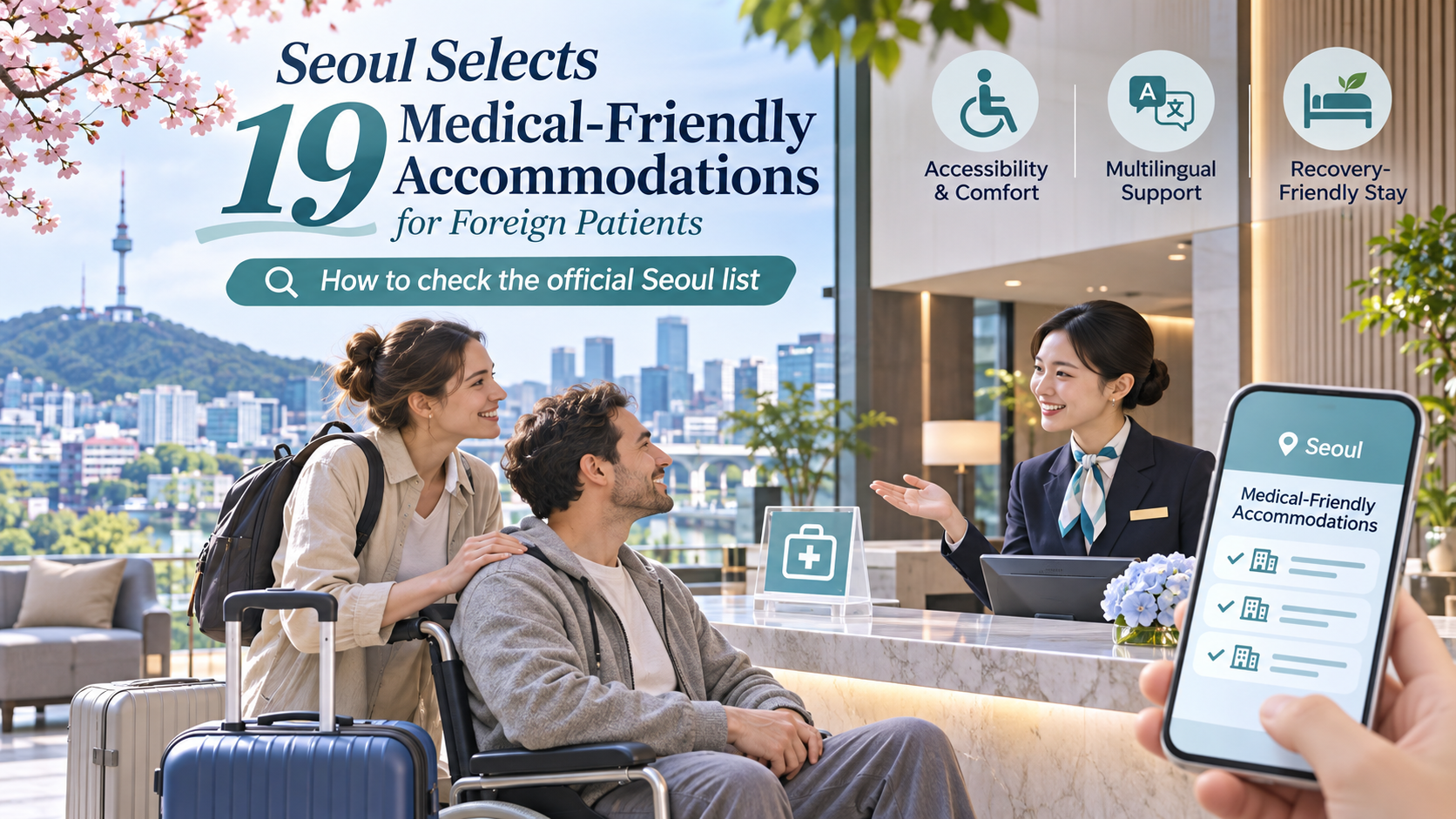
Seoul has selected 19 accommodation properties intended to better serve international medical visitors and accompanying family members, the city government and Seoul Tourism Organization announced on November 2, 2026. The new program is designed around the practical needs that can distinguish a medical trip from a holiday: access to clinics, longer stays, laundry or cooking facilities, transport arrangements and the ability to seek help in an emergency.
The key date is easy to miss. The selections were announced in November 2026, but Seoul says the certificates awarded to selected properties are valid for the 2027 calendar year. The announcement should not be described as a guarantee that every listed hotel already offers every advertised service at the same price today, or that a hotel has been certified to provide medical treatment.
What exactly did Seoul select?
The city called the program “Seoul Medical-Friendly Accommodations,” or 서울 의료친화 숙박시설 in Korean. Forty properties applied in the inaugural selection process, and 19 were chosen after document review, on-site inspections and expert evaluation. The Seoul Tourism Organization's November 2 primary-source announcement explains the assessment process and intended services.
Eleven of the 19 selected properties are in Gangnam District, according to contemporary reporting. The concentration makes practical sense given the district's cluster of medical facilities, but it does not mean every traveler should stay in Gangnam. Where the patient's actual medical appointments take place, how often follow-up visits are required and how accessible the route is may be more important than the district name.
The city assessed access to medical institutions, suitability for longer stays, daily-living amenities such as cooking and laundry, and arrangements for responding to emergencies around the clock. These were criteria for an accommodation program. They are not independent ratings of clinical outcomes or a claim that the hotels have their own licensed medical staff.
Which services can travelers expect?
The official announcement describes examples across selected properties: dedicated medical-tourism floors or lounges, complimentary laundry, pickup and drop-off arrangements, guidance on nearby amenities and multilingual emergency information. These are examples of the group's facilities and support capabilities, not a promise that all 19 offer every item.
Before booking, travelers should ask the specific property whether a given service is available during their dates, whether it is included in the quoted room rate, and whether it requires advance scheduling. The English term “pickup” can refer to airport transfers, transfers to treatment facilities or another arrangement; guests should request a written description instead of assuming it covers all journeys.
For a longer recovery stay, ask whether there is accessible elevator access, an accessible bathroom if needed, a refrigerator, suitable food-preparation space, room-cleaning arrangements, a companion-bed option and a way to reach staff outside normal reception hours. These are practical booking questions—not confirmed features of any particular property in the selection.
Where can visitors find the official list?
Seoul's official Medical Tourism website published the “2026 Seoul Medical-Friendly Accommodations final selection results” on November 2. The notice includes an attached PDF with the selected properties. Travelers should begin with that dated announcement at https://medical.visitseoul.net/notification/notice/noticeRead/282 and follow the linked selection results, then verify the individual hotel's address and services before making a payment.
The full list is intentionally not reproduced here without separately reconciling each property name, website and booking terms. That avoids turning a November announcement into an outdated booking directory. A hotel appearing on a third-party booking site under a similar name is not sufficient proof of its inclusion: check the name against the city's selection notice.
The Seoul Medical Tourism site also provides information about medical-service organizations and overseas visitor support. The accommodation designation, medical-institution listings and patient-facilitation services are different categories of information. Being selected for lodging does not automatically place a property in any medical provider directory.
Why this is happening now
Seoul and the Seoul Tourism Organization cited Korea Health Industry Development Institute figures showing approximately 1.76 million foreign patients using Seoul-based medical institutions in 2025, compared with roughly 470,000 in 2023. The city said the Seoul figure represented 87.2% of the approximately 2.01 million foreign patients reported nationally under the cited statistical framework.
The figures explain why accommodation has become a policy focus. Yet the reported foreign-patient count must not be read as 1.76 million international medical tourists staying overnight in Seoul, nor as a count of guests who used the selected hotels. Medical statistics and hotel booking statistics describe different things. They also do not establish the effectiveness of any individual clinic or treatment.
From a travel-policy perspective, the program links lodging with an established medical-tourism market. The city plans multilingual promotion of selected facilities through official channels and networking with medical organizations and patient-facilitation providers. The announcement did not establish a uniform citywide hotel discount, fixed room prices or a public reimbursement entitlement for foreign patients.
Practical checklist before making a reservation
First, confirm the treatment location and likely follow-up schedule with the medical provider. Then compare travel time from shortlisted properties, considering mobility constraints and the availability of a companion. Next, obtain the hotel's total price in writing, including taxes, extended-stay rules and cancellation conditions. Finally, ask about language support, after-hours contact methods and transport assistance, including any additional charges.
If the visit follows a medical procedure, travelers should use instructions from their qualified treating clinicians to decide what mobility and support they need. A “medical-friendly” hotel may improve logistics, but it does not replace clinical care or emergency services. In an urgent medical situation in Korea, the emergency number is 119; the hotel's front desk may help with language or directions but is not an emergency medical service.
What we're watching
The next useful development will be an accessible multilingual property directory with individual service descriptions, verified booking contacts and clear fee information. We will also watch how the 2027 designation is implemented and whether the city publishes any evaluation of the program's actual use.
For now, the verified news is that Seoul selected 19 properties from 40 applicants and plans to issue certificates valid during 2027. For travelers, the right next step is to consult the official selection notice and confirm the precise services needed with the property—not to treat selection as a medical endorsement.