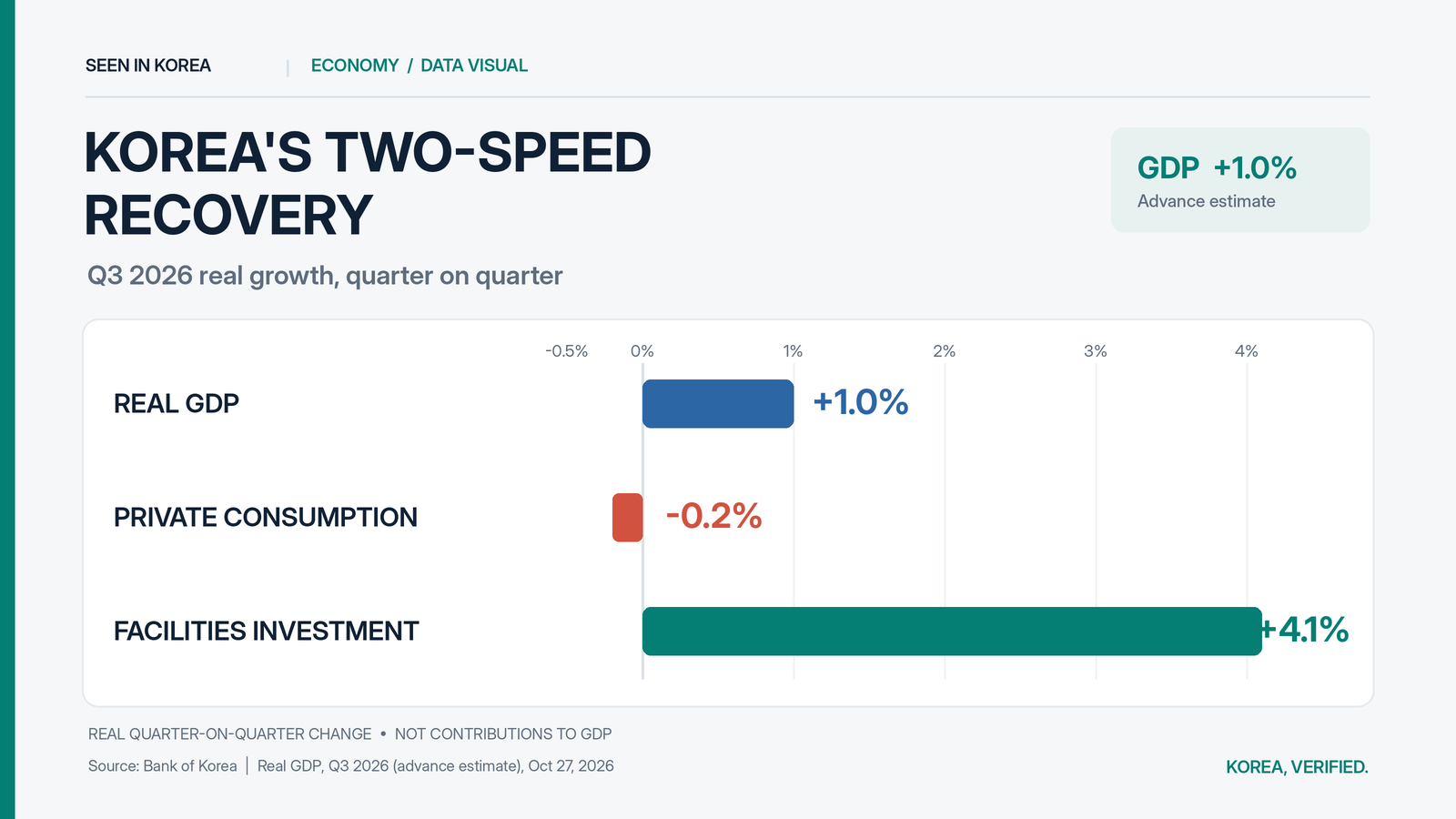
South Korea's economy grew faster than expected in the third quarter of 2026, but the headline masks a striking split between export-led industry and household spending. The Bank of Korea's October 27 advance estimate showed real GDP expanding 1.0% from the previous quarter and 3.4% from a year earlier. The result beat both the central bank's earlier 0.3% quarter-on-quarter projection and the 0.7% median forecast in a Reuters poll. Neither forecast is an actual GDP measure.
The number that matters
Exports increased 2.3% from the second quarter and facilities investment rose 4.1%, driven by semiconductor manufacturing machinery. Private consumption declined 0.2%, its first quarterly fall in nearly four years. Those numbers describe changes in real economic activity, not dollar exports or company profits. Growth in aggregate production therefore coexisted with a decline in private consumption.
Reuters reported that the central bank attributed roughly half of the quarter's economic growth to semiconductors. That estimate makes concentration central to the story. The strongest sectors benefit from global demand for AI-related computing infrastructure and memory chips, whereas other parts of domestic demand do not necessarily receive an immediate benefit.
Why it matters in Korea
GDP aggregates everything produced domestically. A lift in export orders and factory equipment purchases can raise the total even when consumers reduce spending on goods and services. That is why a stronger growth rate cannot alone establish that wage earners or small retailers are better off.
Some of the consumption weakness may be temporary: reported disruptions included slower vehicle deliveries linked to industrial action and reduced financial-services activity accompanying softer stock trading. That caveat matters. One quarterly dip should not automatically become a claim of structural household distress. But neither should temporary explanations erase the very real divergence in the latest observed data.
Why this matters outside Korea
Korea is a significant supplier of memory chips used across global computing hardware. Faster Korean output can therefore be a useful indicator of capital expenditure elsewhere, particularly among operators of AI data centers. At the same time, Korean growth can become sensitive to spending decisions made by a relatively small set of overseas buyers and technology firms.
For international readers, the better question is whether strength in exports and factory machinery eventually spreads into employment, wages, services and consumer demand. That would be broader growth than a chip-led acceleration alone.
The risk—and what could change
The AI hardware investment cycle is not guaranteed to sustain today's pace. Prices and orders can change rapidly, and the advance GDP estimate will be revised as fuller data become available. The BOK's monetary policy choices also reflect inflation and household debt, not GDP growth alone.
How to read the growth breakdown
The quarter-on-quarter and year-on-year figures answer different questions. The 1.0% quarterly rise compares economic output with the immediately preceding three months; the 3.4% year-on-year reading compares output with the same quarter in 2025. Neither is an estimate of household disposable income. Comparisons also depend on the seasonal adjustment and national-accounts methodology used in the advance release. For a globally oriented reader, this is why a headline about Korea beating forecasts does not tell the full story about consumer welfare.
It is also important not to assign every movement in gross domestic product to one industry. Strong semiconductor shipments generate direct manufacturing output, while chip production also requires imported components, equipment and energy. GDP reflects domestic value added rather than gross shipments. The distinction prevents double counting and helps explain why a $1 increase in gross chip exports is not necessarily a $1 increase in Korean GDP.
Finally, an export-led quarter should be assessed alongside subsequent hiring and wage data. If manufacturers invest more in capital-intensive machinery while employment growth stays muted, the benefits may take longer to reach households. This is a question for later releases, not a conclusion established by one quarter's national accounts.
Which part of demand actually grew?
A GDP growth rate is the sum of different components, not a scorecard for each household. In the third quarter, official statistics show government consumption rose 1.9% and facilities investment increased 4.1%, while private consumption slipped 0.2%. Exports grew 2.3% in volume terms in the national accounts. Those separate movements explain how a country can report faster output growth even as some families and neighborhood businesses experience weak demand. The same release shows real gross domestic income rising more rapidly as export prices improved relative to import prices; that supports national purchasing power in the aggregate but does not imply that income gains were evenly distributed.
The advance GDP release is also subject to revision as fuller information becomes available. For overseas readers comparing Korea with another economy, quarterly growth, year-on-year growth and export-value growth answer different questions. None should be substituted for another simply because the percentages look compelling.
What we're watching
The next detailed national accounts release, monthly retail and consumer indicators, semiconductor equipment orders, and whether private consumption recovers. Until those figures arrive, the evidence supports a strong industrial quarter alongside weak household spending—not a uniformly booming economy.