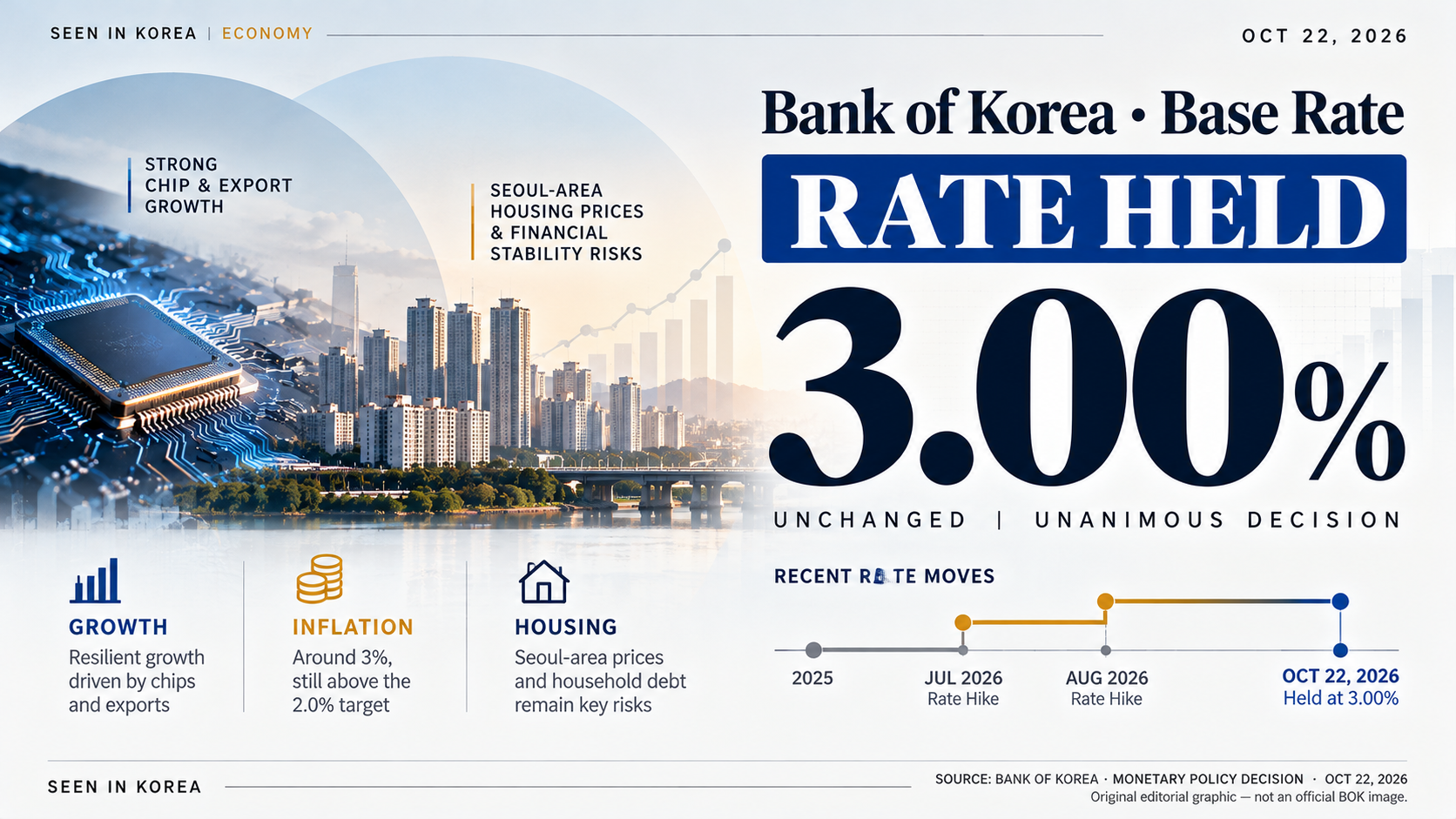
The Bank of Korea held its benchmark Base Rate at 3.00% on October 22, 2026. All seven Monetary Policy Board members supported the decision. The hold was not a signal that policymakers regard economic conditions as weak. Instead, the bank described a powerful but complicated mix of export-led growth, inflation around 3%, persistent financial-stability concerns and unusually uncertain external conditions.
What happened
The BOK said the domestic economy was maintaining strong growth led by exports and investment. It also expects consumption to recover. At the same time, inflation remained around 3%, above the central bank's 2% target. The board wanted more evidence about the effects of two earlier rate increases and the trajectory of overseas risks before changing borrowing costs again.
The October decision came before the advance third-quarter GDP figure was published on October 27. It would therefore be misleading to claim that the board had already seen the later 1.0% GDP result when voting. The official decision referenced forecasts and information available as of October 22.
The number that matters
The 3.00% Base Rate is the policy rate chosen by the central bank. It is not the mortgage rate charged to every borrower or the interest earned on a particular bank deposit. Retail lending rates also reflect funding costs, credit risk, bank competition and loan characteristics.
Why it matters in Korea
Higher rates generally restrain demand by making borrowing more expensive, but they cannot directly increase housing supply or resolve every cause of elevated prices. In Korea, policymakers watch Seoul-area home prices and the composition of household borrowing particularly closely. The BOK noted that while overall household loans declined as other loans were repaid, housing-related loans continued to rise and the pace of local home-price increases accelerated again.
That difference matters: aggregate credit may look stable while specific types of leverage build financial risk. It helps explain why policymakers can remain cautious even when some measures of borrowing soften.
Why this matters outside Korea
Overseas investors and companies monitor the won, bond yields and Korean financial conditions. Interest-rate decisions influence local financing costs and exchange-rate expectations, while international oil prices, US monetary policy and technology investment affect conditions the BOK cannot control directly. Korea's rate decision therefore reflects both domestic inflation and the globally connected manufacturing cycle.
The risk—and what could change
Stronger consumption or persistent inflation could increase pressure for additional tightening. Conversely, worsening external demand, lower energy prices or clearer evidence that prior hikes are slowing the economy could alter the balance. None is a guaranteed next move. The BOK explicitly said future decisions would depend on incoming evidence.
What the decision does not say
An unchanged base rate does not mean credit conditions are identical for every borrower. Commercial banks can change mortgage pricing, deposit promotions or loan approval standards even without a new central-bank decision. In addition, a household already on a fixed-rate loan will feel policy changes differently from a business rolling over short-term credit. Transmission occurs with lags, so the BOK has reason to watch results from earlier moves before another decision.
The bank also distinguishes headline inflation from medium-term inflation expectations. Temporary changes in oil and food prices can change the monthly index, whereas broadening wage and demand pressures may make elevated inflation more persistent. The October communication did not give investors a mechanical threshold at which rates must rise; rather, it identified the set of evidence that matters.
International readers should be cautious about interpreting Korea through the US Federal Reserve alone. Currency movements, foreign demand and capital flows matter, but the BOK also has domestic responsibilities. In a country with significant mortgage exposure and technology exports, economic strength and financial vulnerability can coexist, requiring more than a simple growth-versus-rates narrative.
Why a hold was not a promise to stop tightening
The board explicitly said it would assess the timing and pace of further increases, not that the tightening cycle was over. It also stressed that earlier rate hikes take time to affect borrowing costs, spending and housing-market expectations. If monetary policymakers move too quickly, they risk responding before they can observe whether previous decisions are already slowing inflation and credit growth. If they delay too long, persistent inflation or financial imbalances could become harder to contain.
For households and foreign businesses, the distinction is practical. A policy rate held at 3.00% does not fix every mortgage or corporate loan at 3.00%; lenders add their own funding, credit and maturity spreads. Nor does it mean that future monetary decisions are predetermined. The next inflation report, housing indicators and external financing conditions will help explain the direction of policy better than the word 'hold' alone.
What we're watching
October inflation data, updated growth projections, household housing-loan trends and the next Monetary Policy Board decision. The key takeaway is not a prediction of the next rate change: it is that growth, prices and financial stability are moving on different tracks.