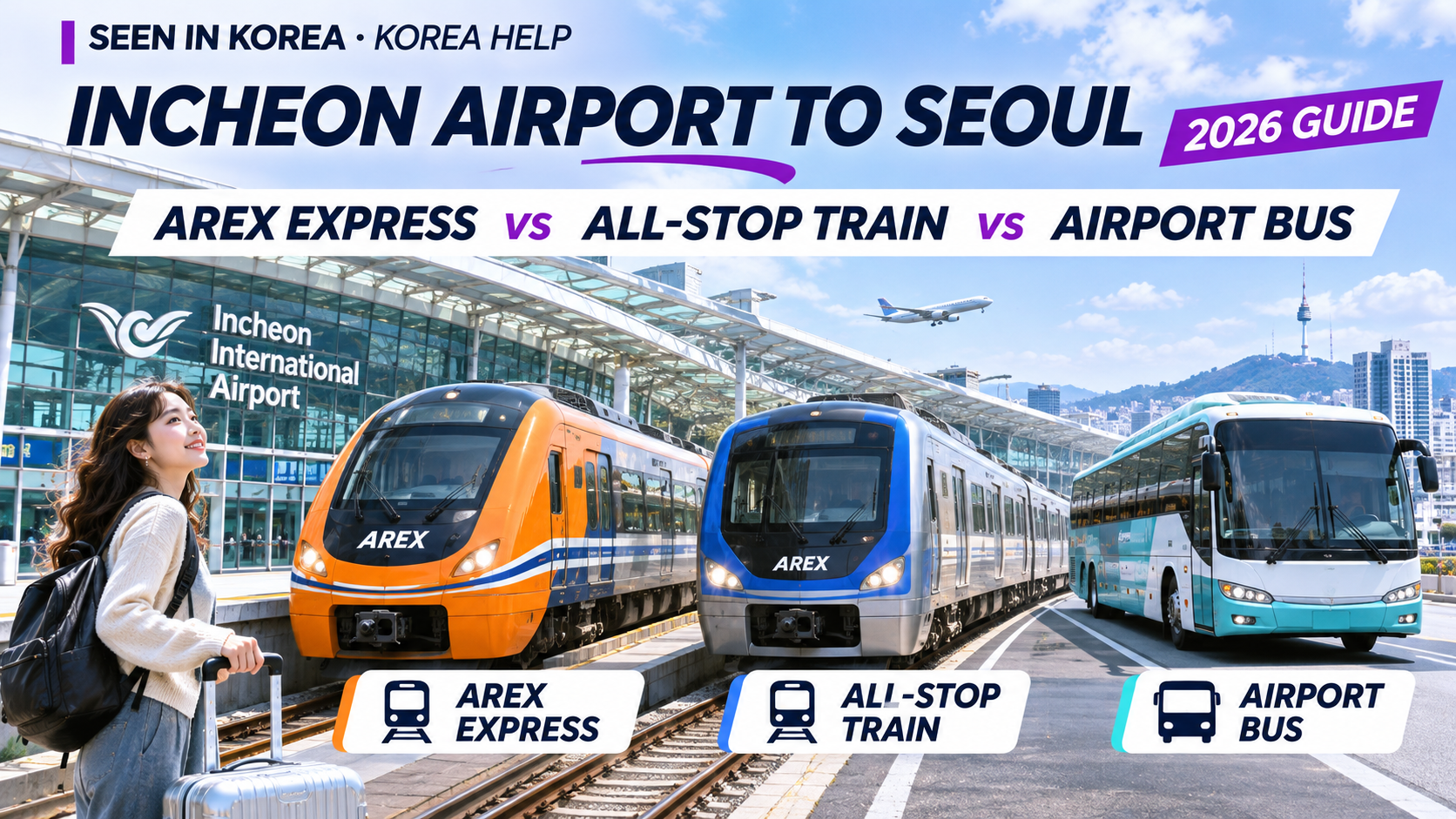
You have landed at Incheon International Airport. Your hotel may be in Myeongdong, Hongdae, Gangnam, Yeouido or somewhere else entirely—and that matters more than a generic recommendation to take the airport train. The best transfer depends on the final destination, arrival terminal, amount of luggage and time of day.
Seoul's official tourism guide compares the Airport Railroad Express (AREX), its all-stop train, airport limousine buses and taxis. Here is a decision guide built from those published routes and fares, not an on-site trial.
At a glance: your four choices
- AREX Express: Reserved seating, non-stop between Incheon Airport and Seoul Station. The Seoul tourism guide lists ₩13,000 for adults from Terminal 1 and a 43-minute journey to Seoul Station. It is useful if Seoul Station is your actual destination or a straightforward transfer point.
- AREX all-stop train: Subway-style seating with stops including Gimpo Airport, Digital Media City, Hongik University, Gongdeok and Seoul Station. The published adult fare from Terminal 1 to Seoul Station is ₩4,750 with a transport card; Terminal 2 or other destinations can differ.
- Airport limousine bus: Often a better door-to-neighborhood option for travelers with heavy bags. Seoul's visitor guide places typical adult prices around ₩16,000–₩18,000, depending on the route.
- Taxi or call van: Potentially practical for several travelers sharing a fare or arriving beyond train operating hours. Traffic, tolls, vehicle category, luggage and app charges can change the actual cost.
The cited travel times and prices are official visitor-guide snapshots from June 2026, mostly referencing Terminal 1, not promises for every terminal and departure.
AREX Express: fast to Seoul Station, but not every hotel
The Express service makes a non-stop run to Seoul Station, has assigned seats and requires its own ticket. Do not tap a standard subway transport card and assume it covers the Express fare. The official Seoul guide lists an adult fare of ₩13,000 and a child fare of ₩9,500 for the Terminal 1 journey, and says the Express reaches Seoul Station in about 43 minutes.
That sounds universally attractive, but arrival at Seoul Station is not necessarily arrival at your hotel. A guest staying in Hongdae would still need another connection if taking Express. Someone traveling to Myeongdong must transfer to the subway, walk, take a bus or book a taxi from Seoul Station. When comparing options, add the transfer and luggage-handling time.
Use the official AREX website or the transport information shown in the terminal to check the specific day's departure time, booking conditions and applicable fare.
AREX all-stop: often the better value for Hongdae
The all-stop train follows an airport-to-Seoul route that includes Hongik University Station and Gongdeok before Seoul Station. Unlike the Express, it does not require a reserved seat and may be crowded at peak times.
For a traveler staying around Hongdae or Yeonnam-dong, the all-stop train can be more direct than the faster Express because there is no need to travel to Seoul Station and back. The official Seoul guide gives the Terminal 1 to Seoul Station transport-card fare as ₩4,750 and an approximate all-stop journey time of 59 minutes. Fares vary by terminal and destination, so the Hongdae price and journey duration should be checked separately.
The all-stop choice is also useful for transfers to Gimpo Airport, Digital Media City and Gongdeok. If your final stop is on Seoul Subway Lines 2, 5, 6 or 9, the best connection may be at one of those stations rather than Seoul Station.
Airport bus: the luggage advantage
The limousine bus makes more stops but may drop you closer to your lodging. Seoul's official travel guide gives the following example routes from Incheon Airport Terminal 1:
- Myeongdong area: Bus 6001 is listed as an option near Myeongdong Station.
- Hongdae area: Bus 6002 is listed as an option near Hongik University Station.
- Gangnam area: Bus 6020 is listed for the Gangnam Station area.
This is a route-finding starting point, not proof that every hotel sits beside a stop. Check your actual bus stop and operating schedule at the airport. The official guide says travelers normally purchase tickets at a terminal kiosk or counter, confirm the boarding stop and collect a baggage claim tag when larger bags are loaded. It also describes baggage restrictions, so travelers with oversized luggage should confirm with the operator before boarding.
The trade-off is traffic: a bus is not guaranteed to beat the train, particularly when congestion is heavy.
What if you arrive after the last train?
Do not assume AREX or regular airport buses run all night. Incheon International Airport publishes dedicated Seoul late-night bus timetables for Terminal 1 and Terminal 2, including N6000 and N6002 services, and these terminals have different departure times. The airport also publishes separate late-night services for Gyeonggi destinations.
If your flight lands late, leave time for immigration, luggage collection and the walk to the bus stop. Check the terminal-specific timetable on your actual arrival day and identify the stop where you will get off. A bus dropping you at a large transport hub may still require a separate taxi to your accommodation.
Useful official pages: Terminal 1 late-night Seoul buses and Terminal 2 late-night Seoul buses.
Which option makes sense for your destination?
Hongdae or Yeonnam-dong: Start by checking the AREX all-stop train to Hongik University. Express may be a detour, and a bus may help if your luggage is heavy and its actual stop is near the hotel.
Myeongdong: Compare AREX to Seoul Station followed by a transfer against a direct neighborhood bus such as 6001. The bus may reduce luggage transfers; the train avoids road traffic.
Gangnam: A relevant airport bus or taxi may be easier than multiple train changes. Compare the terminal-specific route and your hotel's exact street address.
Seoul Station or onward KTX: AREX Express is a natural option to compare, but allow adequate connection time before any reserved intercity train. See our KTX tickets with a foreign card guide.
Tickets, foreign cards and a common mistake
The Korea Tourism Organization's 2026 international-visitor transport guide states that foreign-issued cards are accepted at relevant rail ticket machines and counters, with conditions varying by operator and product. That does not mean every machine, transport card top-up or bus payment method has identical rules. Keep a backup payment option and read the screen before paying. For a broader explanation, see our Seoul transit payment guide.
Bottom line: Choose the train or bus that gets you closest to the hotel with the fewest avoidable transfers. Compare a full door-to-door journey, not only the published speed or ticket price of one segment.
Sources and verification
- Seoul Tourism Organization: Getting to Seoul, AREX and airport buses
- Korea Tourism Organization: 2026 visitor transportation and payment guide (PDF)
- Incheon Airport: Terminal 1 Seoul late-night buses
- Incheon Airport: Terminal 2 Seoul late-night buses
*Editorial method: Publicly listed fares, routes and train durations compared as of November 17, 2026. No direct booking or airport journey was performed. Timetables, traffic and fees can change; confirm with the transport operator before travel.*